What to Wear on a Columbia Icefield Tour: A Practical Packing Guide
The Columbia Icefield sits high enough that summer temperatures at the toe of the Athabasca Glacier can feel like a winter day in Jasper. Being underdressed is the single most common reason a glacier visit goes badly, and the fix costs nothing but planning.
Short answer
Dress in three layers: a moisture-wicking base, an insulating mid layer, and a windproof shell, plus closed-toe walking shoes and warm accessories even in July. The Athabasca Glacier sits at high elevation where wind and near-freezing temperatures occur in every month, and Jasper lost 21.8 percent of its glacier mass between 1985 and 2024, so the ice you stand on is genuinely cold country.
Why the Columbia Icefield is cold even in July
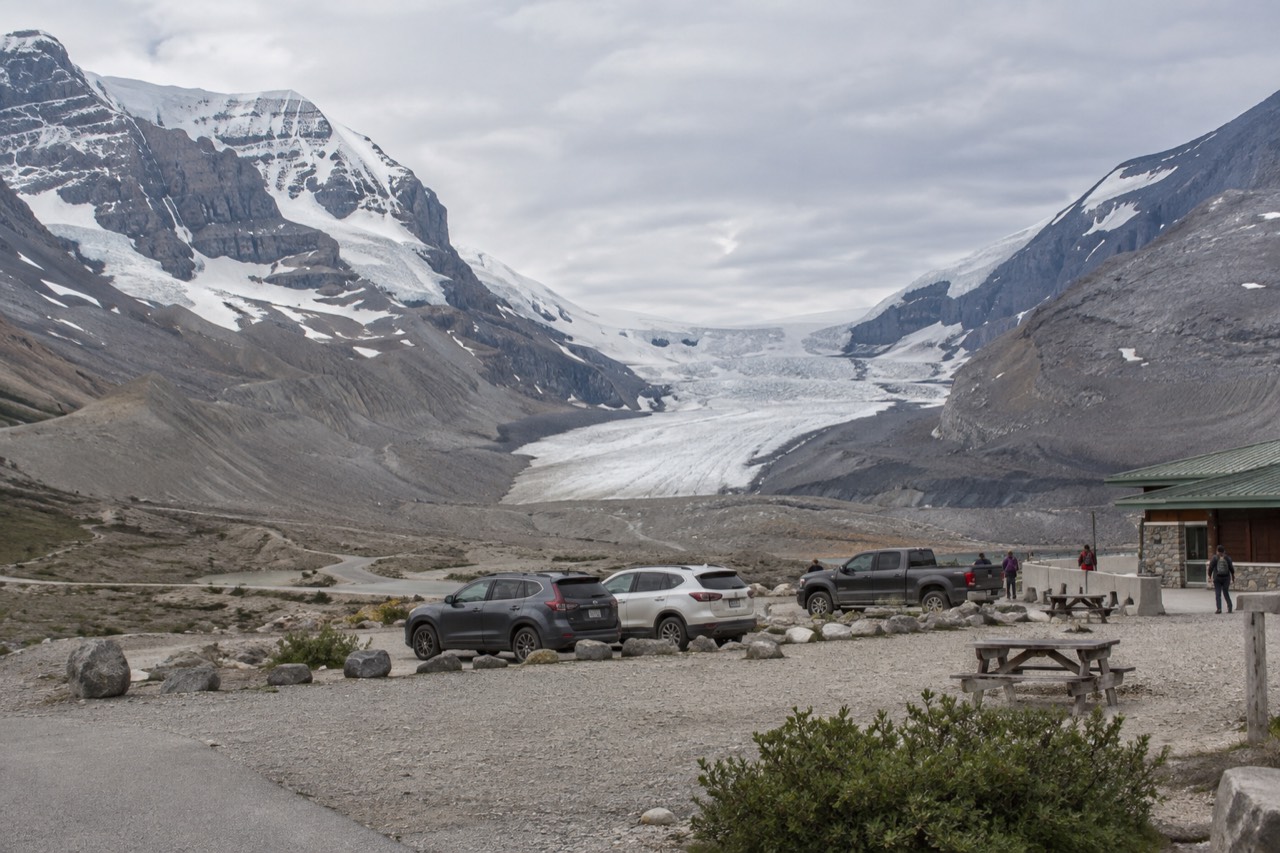
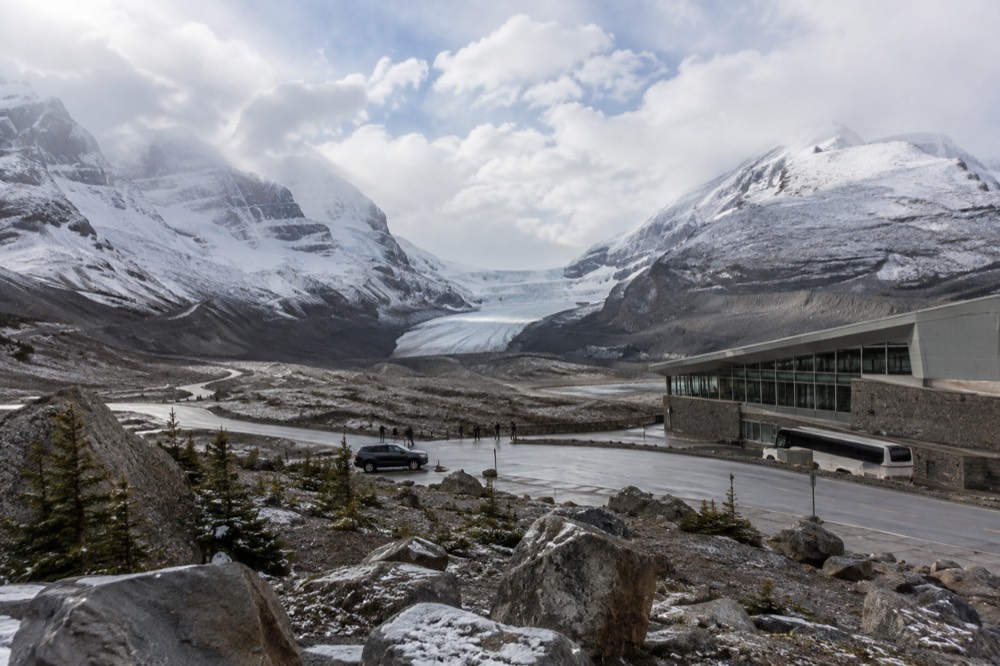
The Athabasca Glacier sits at high elevation on the largest icefield in the Canadian Rockies, more than 300 square kilometres of ice, and elevation plus wind plus proximity to the ice itself keeps temperatures far below what the Jasper townsite thermometer says. Parks Canada records that the glacier has been receding for 125 years and that 2023 saw more ice melt than in any of the previous ten, but melt does not mean mild. Visitors routinely arrive in shorts because the town was warm at breakfast, then spend two hours shivering at the Icefield Centre. The gap between Jasper's valley weather and the icefield's alpine weather is the whole reason this page exists.
The numbers explain the gap. Jasper's climate normals put July's average daily maximum at 23.4 °C in town, but the Icefield Centre is 103 km south of Jasper on Highway 93, at the top of the Sunwapta Pass climb, where long steep grades of 8 to 11 percent lift the road into a different weather zone. The glacier's surface reflects sunlight, the wind off the ice is constant, and the meltwater running off the toe is close to freezing. Standing on the ice itself, the air a metre above the surface behaves like a refrigerator door left open.
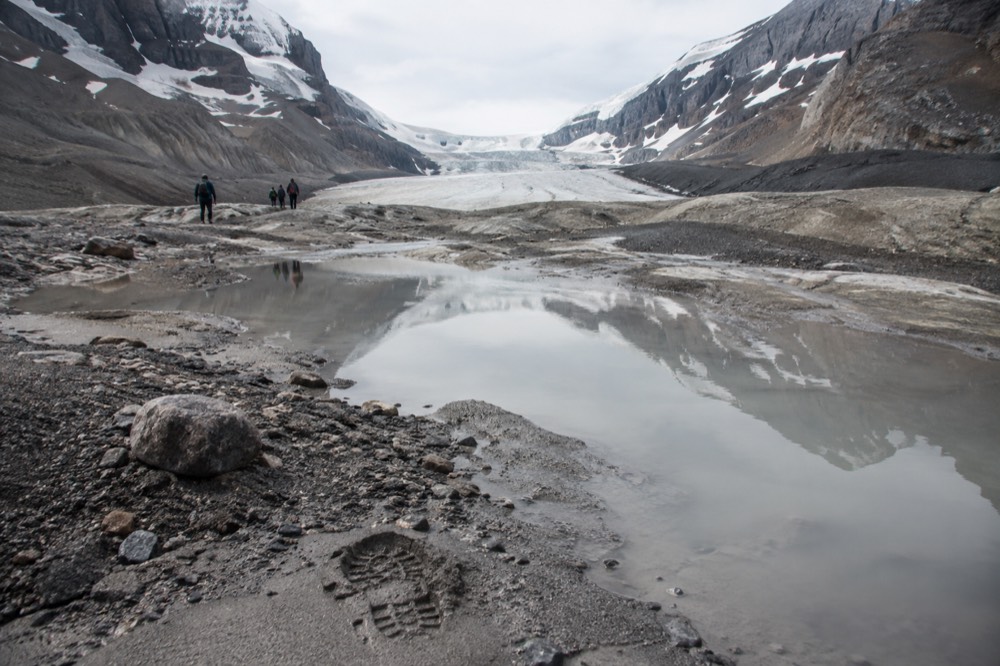
There is a second, less obvious reason to take clothing seriously: the ice is changing, and the terrain around it is changing with it. From 1985 to 2024, Jasper lost 21.8 percent of its total glacier mass, and the Columbia Icefield alone lost nearly 13.3 percent over the same period. The toe of the Athabasca retreats and reshapes the moraine around it year by year, which means more loose rock, more meltwater channels, and more surfaces that are wet, dusty or slippery underfoot than the photos in older reviews suggest. Good footwear handles all three.
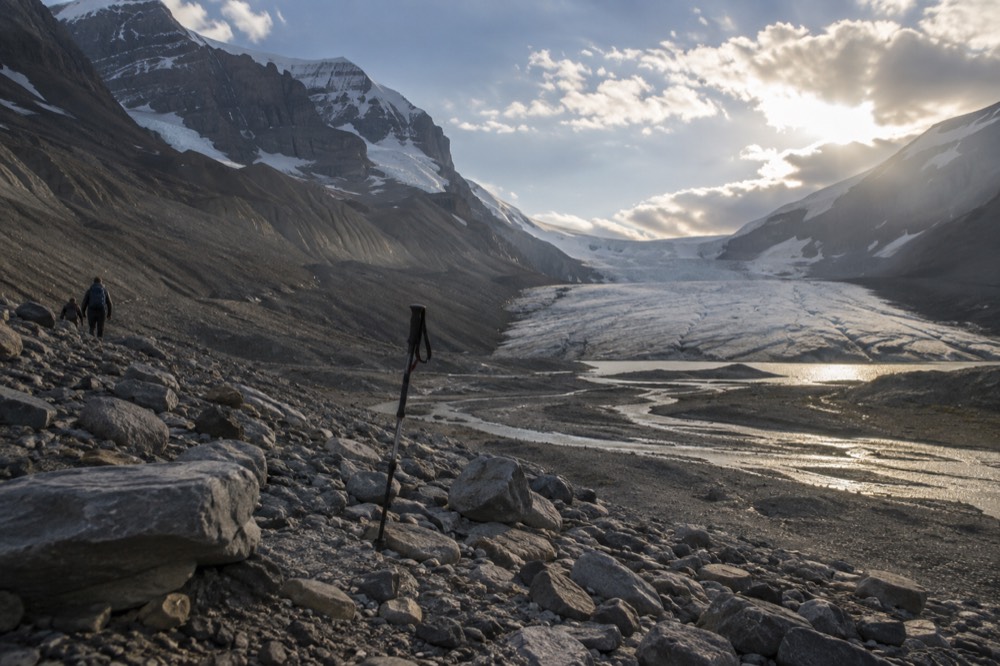
Parks Canada's own safety wording on the glacier is blunt: the ice is dangerous, people have been killed falling into hidden crevasses, and the barriers exist for a reason. Clothing will not protect you from a crevasse, but the right outfit keeps you comfortable long enough to pay attention to where you are walking, and comfort is a safety system in cold, windy country. If you are still deciding which glacier experience to book, our Columbia Icefield tours guide compares the options, and the Athabasca Glacier tours guide covers the hiking products specifically.
What to wear on a Columbia Icefield tour: the three-layer system
Wear a moisture-wicking base layer against your skin, a warm insulating mid layer such as a fleece or light down jacket, and a windproof and waterproof outer shell. Three thin layers beat one thick coat because you can shed or add a layer at the Icefield Centre, on the bus, and on the ice itself, and because trapped air between layers insulates better than a single heavy garment. The system works for the Ice Explorer, the Skywalk, a guided glacier hike, and the drive between stops alike.
The base layer is the one people get wrong most often. Cotton t-shirts and jeans absorb sweat and meltwater and then hold that moisture against your skin, where the wind chills it fast. A synthetic or merino base layer moves moisture outward and keeps drying even while you wear it. This matters on the glacier in particular: guided glacier hikes supply and fit crampons, and walking on ice in stiff boots generates real body heat, so you will sweat on the climb and then freeze the moment you stop for photos.
The mid layer is your thermostat. A fleece pullover or a light insulated jacket adds warmth without bulk, and it compresses into a daypack when the sun comes out. The shell is the piece that earns its space even on a clear forecast: the wind off the Athabasca Glacier is a constant, and a shell that blocks it turns a cold hour into a comfortable one. Rain on the icefield rarely falls as a downpour, but a waterproof shell also doubles as protection from the fine spray near melt channels.
| Layer | What it is | Why it matters at the icefield | Example choices |
|---|---|---|---|
| Base | Snug synthetic or merino top and bottom | Moves sweat away from skin, keeps drying while worn | Merino tee, synthetic long-sleeve, light leggings |
| Mid | Fleece or light insulated jacket | Traps warm air, compresses into a pack when not needed | Fleece pullover, light down or synthetic puffer |
| Shell | Windproof, waterproof jacket and over-trousers | Blocks constant glacier wind and light rain or spray | Rain shell, softshell, packable windbreaker |
| Accessories | Hat, gloves, sunglasses, buff | Small items with outsized effect on comfort | Fleece beanie, light gloves, UV sunglasses |
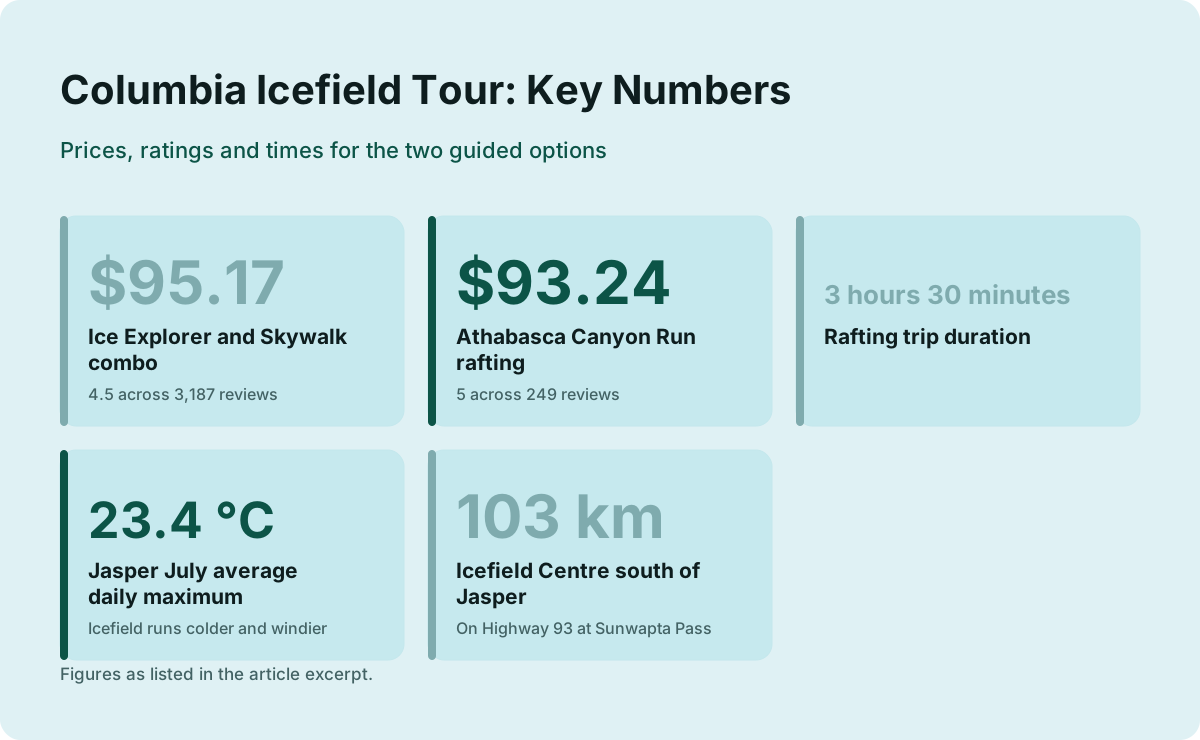
If you are comparing guided products rather than going self-directed, the choice below pairs the guided glacier hike with the Ice Explorer combo and a family rafting option for contrast. The Ice Explorer and Skywalk combo is the high-volume choice at 4.5 across 3,187 reviews from $95.17, while the guided hike trades the bus for crampons and a guide.
Footwear for the glacier: what to wear on ice and moraine
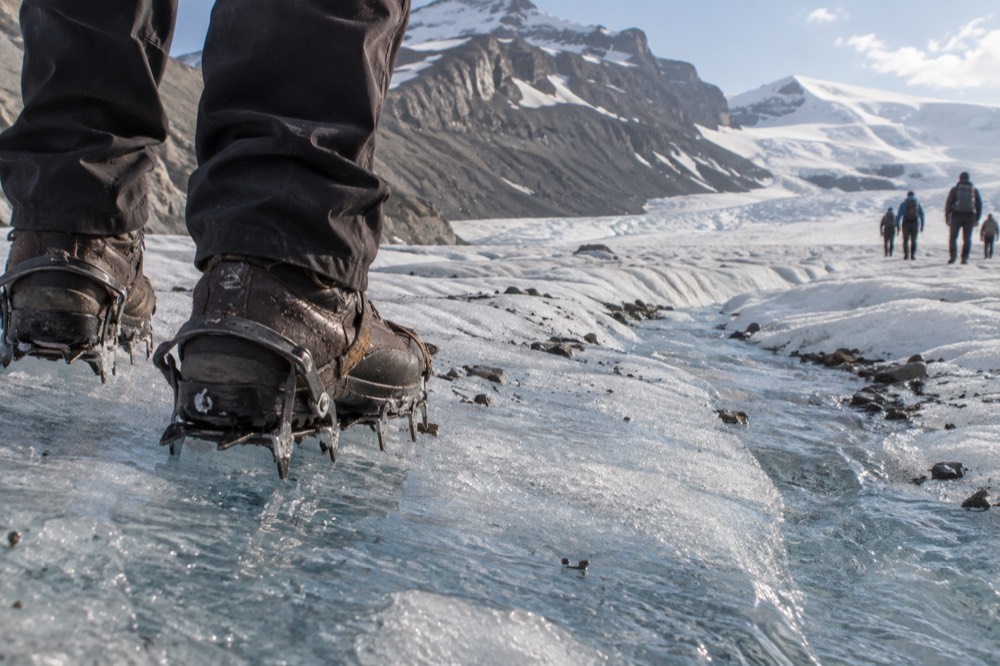
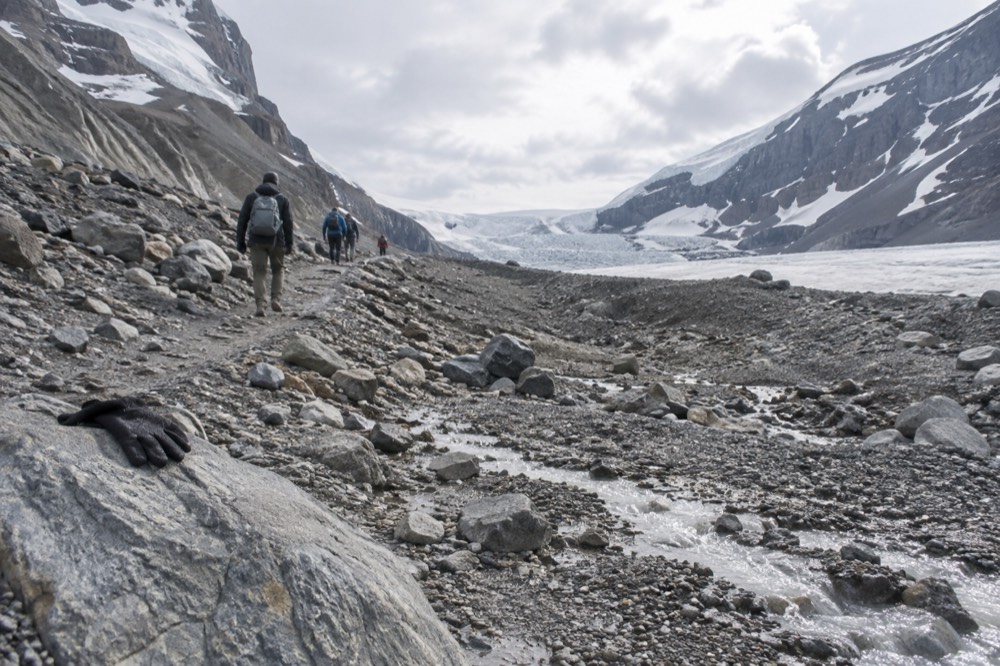
Wear closed-toe walking shoes or light hiking boots with a grippy, lugged sole for the Skywalk and the Discovery Centre, and stiff-soled waterproof hiking boots for a guided glacier hike, where the operator supplies and fits crampons that need a supportive boot to bite properly. Sandals, canvas sneakers and smooth-soled shoes fail on all three surfaces: bare rock, moraine gravel and glacial ice. The right footwear is the difference between a confident stride and a cautious shuffle.
The surfaces at the icefield are harder than they look from the parking lot. The paved and graveled paths around the Columbia Icefield Skywalk and Discovery Centre are easy, but the viewing areas near the glacier toe are bare rock and loose moraine, and meltwater crosses several of them. Parks Canada's warning about hidden crevasses applies beyond the barriers, and the terrain just inside the public zone is still uneven, wet in patches, and sharp under thin soles.
On a guided glacier hike the operator brings the technical gear, including crampons, but crampons only work mounted on a boot with a reasonably stiff sole and some ankle support. A flexible trail runner flexes under the crampon frame and the points never seat properly, which is why reputable operators publish a boot requirement in their listing. Check the inclusions and requirements on the live listing before you drive out, because the IceWalks guided glacier hike, 4.9 across 422 reviews from $101.57, runs three hours on the ice and there is no shop at the glacier selling boots.
| Surface | Where you meet it | Footwear that works | Footwear that fails |
|---|---|---|---|
| Paved paths and boardwalk | Skywalk, Discovery Centre, viewpoint plazas | Any closed-toe walking shoe | Flip-flops, anything with no grip |
| Moraine and gravel | Toe of the Glacier trail, parking margins | Lugged hiking shoes or boots | Smooth-soled sneakers, canvas shoes |
| Glacial ice | Guided glacier hikes with crampons | Stiff-soled waterproof boots | Trail runners, soft athletic shoes |
| Wet rock near melt channels | All public areas near the toe | Rubber-lugged soles, waterproofing | Worn-smooth soles, suede that soaks |
What to wear if you are visiting with kids
Dress children in the same three-layer system as adults, one size up on the shell so it fits over a fleece, with waterproof shoes rather than sneakers, a warm hat that covers the ears, and gloves even in midsummer. Children lose heat faster than adults, they sit still on transport longer, and the icefield's wind finds anyone standing still at a viewpoint, so kids need one more layer than you think. The family products in the region are built around this reality.
The glacier corridor is actually one of the easier places in the Rockies to dress a family, because the Columbia Icefield Adventure keeps most of its experience inside a vehicle and on groomed surfaces: the Ice Explorer drives onto the ice and the Skywalk is a cliff-edge walkway with a glass floor. The main failure mode is the drive down the Icefields Parkway with a child in shorts who then refuses to leave the bus at the glacier. Pack the layers in the daypack and hand them over at the parking lot, not back in Jasper.
Families often pair the icefield with a warm-weather activity the same day, and the contrast is worth planning for. The Athabasca Canyon Run family rafting trip, 5 across 249 reviews from $93.24 for 3 hours 30 minutes, runs Class II plus rapids on the Athabasca River, and its clothing logic is the opposite of the glacier's: quick-drying layers, a change of clothes for after, and shoes that can get wet. If you are doing both in one day, keep the dry glacier outfit in the car and change between them.
Accessories that earn their space: hats, gloves, sunglasses, sunscreen
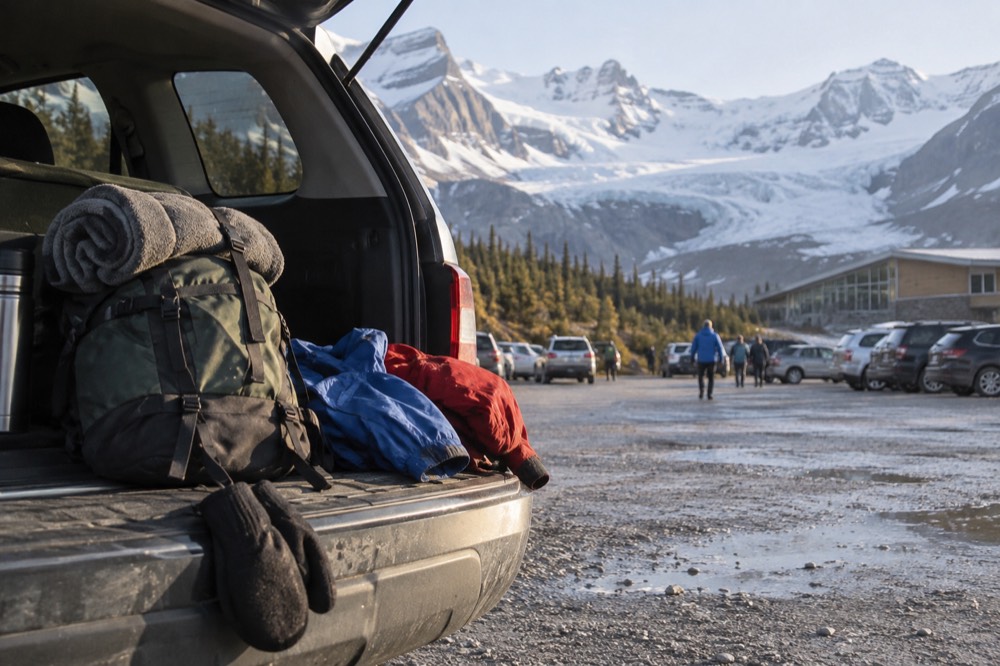
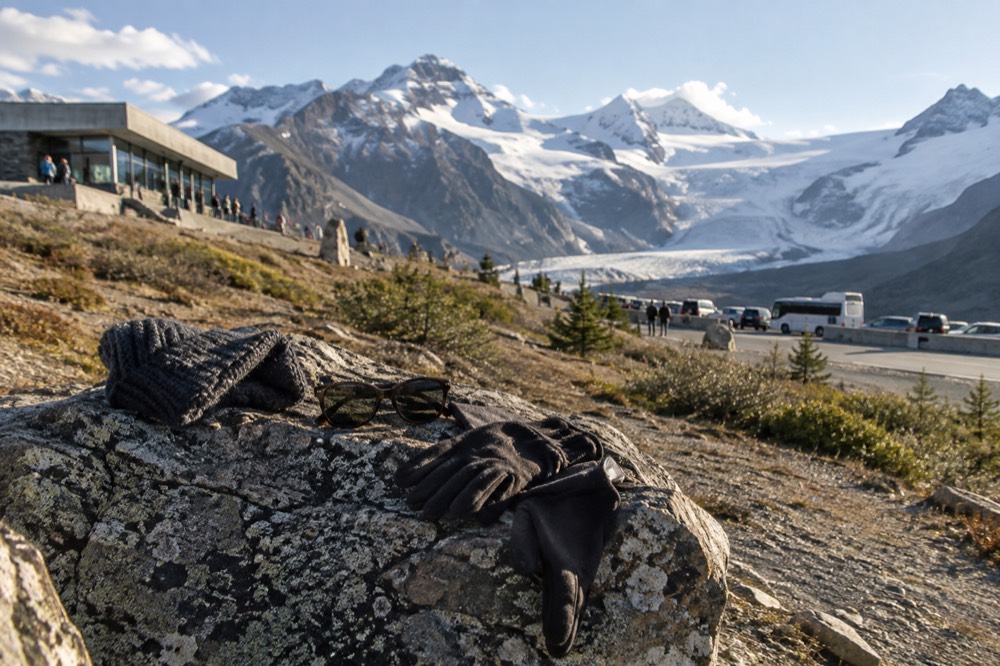
Bring a warm hat, light gloves, UV-rated sunglasses and sunscreen on every icefield visit in every month, plus a buff or neck gaiter for the wind. Sun protection matters as much as warmth: glacial ice reflects a large share of incoming sunlight back up at your face, and at high elevation the thinner atmosphere filters less ultraviolet radiation, so a sunburn on a cold windy day is a real and common outcome. None of these items is heavy.
The sunglasses point deserves emphasis because it is the one that surprises people. A full day around snow patches and ice in bright weather exposes your eyes to reflected glare from below as well as direct sun from above, and cheap fashion lenses do not block enough UV to matter at elevation. Polarized or category 3 lenses are the standard recommendation for snow country. Sunscreen belongs on face, ears, neck and the underside of the chin, and lip balm with SPF is the item almost everyone forgets.
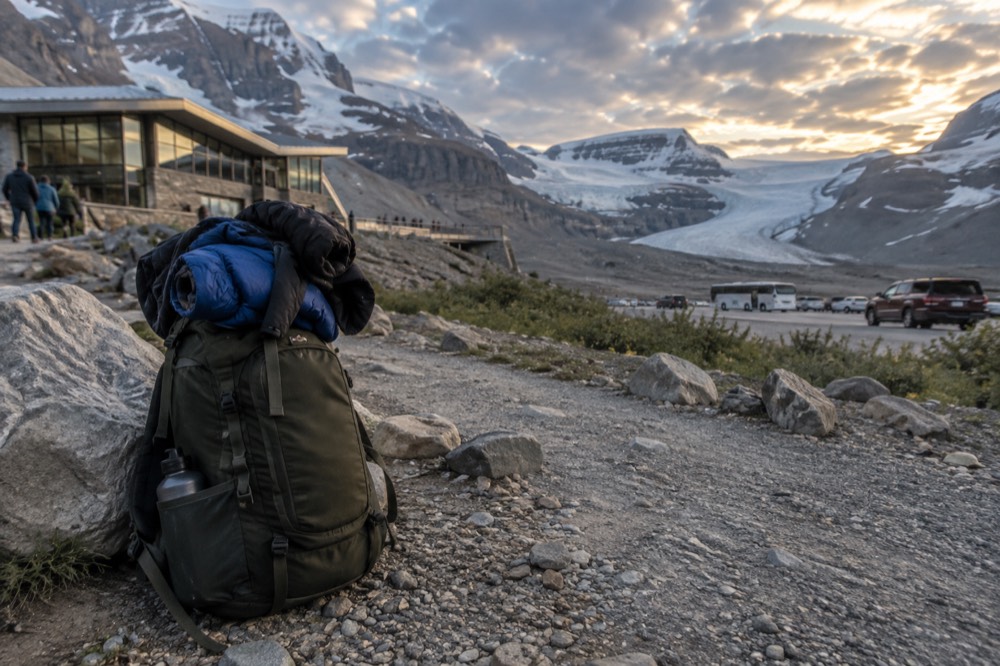
Gloves are the second surprise. The wind off the Athabasca Glacier moves through the Sunwapta Valley headwall and across the Discovery Centre plaza all day, and hands are the first thing to go numb for anyone photographing the ice for twenty minutes. A thin fleece or liner glove is enough for summer visits, and it still lets you work a phone camera. A buff covers the gap between collar and hat that otherwise funnels wind straight down your neck at the Skywalk's exposed viewpoints.
What not to wear on a glacier tour
Do not wear cotton as your only layer, jeans, sandals, smooth-soled sneakers, brand-new unworn boots, or a single thick coat with nothing underneath. Cotton holds sweat and meltwater against your skin and chills you fast, jeans stay wet for hours, and one heavy coat cannot be adjusted when the weather flips between sun, wind and light rain, which it does at the icefield within a single hour. Every item on this list has a cheap, light replacement.
The unworn-boots point is the one that costs people their booking. A stiff new hiking boot needs a week or two of walking before it stops punishing your heels, and a guided glacier hike is three hours of a crampon frame pressing the boot's edges into your foot. Break the boots in around town before the trip, or wear well-fitted boots you already own. Operators check footwear at check-in for the guided ice products, and a guest in the wrong shoes can be turned away without a refund, so treat the listing's requirements as binding.
| Skip it | Why it fails at the icefield | Wear instead |
|---|---|---|
| Cotton t-shirt as base layer | Holds sweat and meltwater, chills rapidly | Merino or synthetic base layer |
| Jeans | Stay wet, restrict movement on ice | Synthetic hiking trousers or leggings |
| Sandals or flip-flops | Bare rock, gravel, meltwater, cold surfaces | Closed-toe shoes or boots |
| One heavy parka | Cannot adjust as conditions flip | Three-layer system |
| Brand-new boots | Blisters and heel damage over three hours | Broken-in boots or sturdy shoes |
| Fashion sunglasses | Inadequate UV block at elevation | UV-rated polarized lenses |
Columbia Icefield weather by month: how cold is it really
Plan around Jasper's valley temperatures and then subtract for elevation: town averages range from a July maximum of 23.4 °C to a January maximum of -3.2 °C, but the icefield runs noticeably colder and windier than town in every month. Snow can fall at the icefield in any month of the operating season, so the shell and hat travel with you in August.
The table below uses Environment and Climate Change Canada's 1991 to 2020 climate normals for the Jasper station, which is the closest long-record station to the icefield and the only verified temperature series available. Treat these as the valley baseline and assume the glacier corridor sits several degrees below them, with wind chill doing most of the damage. The glacier products do not run in deep winter, so the shoulder months of May, September and October are where the biggest clothing surprises live.
| Month | Jasper average daily max | Jasper average daily min | Typical snow days | What it means for clothing |
|---|---|---|---|---|
| May | 16.4 °C | 0.9 °C | Occasional | Full three layers, hat and gloves, winter-capable shell |
| June | 20.0 °C | 5.2 °C | Rare | Three layers, shell in the pack |
| July | 23.4 °C | 7.4 °C | None | Base plus mid, shell for the wind |
| August | 23.0 °C | 6.1 °C | None | Base plus mid, shell for the wind |
| September | 17.9 °C | 2.5 °C | Occasional | Full layers, warm hat, gloves |
| October | 9.9 °C | -2.4 °C | Regular | Winter-grade layers, insulated jacket, gloves |
A few practical notes sit on top of the table. The Icefields Parkway, the 232 km route the icefield sits on, requires snow tires or chains from 1 November to 31 March, which tells you what the road itself thinks of the shoulder seasons. There are no services along the parkway in winter and no cell coverage en route, so the clothing you pack is the clothing you have. And a park pass is legally required to be in Jasper National Park, including to drive the parkway, at $12.25 CAD per adult per day with a Family/Group rate of $24.50 CAD covering up to seven people in one vehicle; check the current figures on the Parks Canada fee page, because fees rise annually. Our Jasper National Park entry fee guide covers the pass question in full.
A packing checklist for each glacier tour type
Pack the three-layer core for every icefield product, then add tour-specific items: boots and a daypack for the guided glacier hikes, a camera and a warm hat for the Ice Explorer and Skywalk combo, and nothing heavier than a light jacket for a Skywalk-only visit from the townsite. The guided hikes are the only products where the operator's gear list overrides your own judgement, so read the live listing's requirements section before packing.
The guided glacier hike is the most demanding product on clothing. IceWalks runs three hours on the ice, and the Tread Lightly four-hour hike runs longer, both supplying crampons and expecting you to arrive dressed for sustained cold with broken-in boots. The small-group Ice Odyssey runs two hours from $201.66 and is the most gear-light of the guided options because of its shorter exposure window. By contrast, the Skywalk admission ticket from $37.01 is a walkway experience where the clothing question is simply wind and sun protection, and the townsite-departure option means you can keep spare layers in the car.
| Tour type | Clothing you must bring | Gear the operator supplies | Extras worth packing |
|---|---|---|---|
| Guided glacier hike (IceWalks, Tread Lightly) | Three layers, broken-in stiff boots, hat, gloves | Crampons, safety gear, guide | Sunglasses, sunscreen, water, snacks |
| Ice Explorer and Skywalk combo | Windproof layers, closed-toe shoes | Transport onto the ice, Skywalk admission | Camera, hat, buff |
| Skywalk admission only | Light layers, windproof shell | Skywalk access | Sun protection, water |
| Small-group Ice Odyssey | Three layers, boots per listing | Glacier equipment, small-group guide | Sunglasses, gloves |
| Full-day Jasper to Banff tour | Layers for multiple stops, comfortable shoes | Transport, guiding | Daypack, snacks, chargers |
One last planning note: the glacier corridor is a full-day outing for most visitors, and the drive itself is part of the experience. Our Icefields Parkway tours guide covers the route products, and the blog post on summer temperatures at the Columbia Icefield goes deeper on the weather question. Parks Canada's own Columbia Icefield and Athabasca Glacier page is the authority on the site's safety rules, and the operator's official attraction page carries the season dates. Whatever you book, Jasper National Park Tours exists to protect exactly this kind of purchase: the right ticket, worn with the right clothes.
Common questions about what to wear on a Columbia Icefield tour
Do I need a winter jacket for the Columbia Icefield in summer?
No, but you need a warm mid layer and a windproof shell. A fleece or light insulated jacket under a wind-blocking shell handles the glacier wind in July and August, and it packs down when the sun is out. A heavy winter parka is bulk without flexibility.
What shoes should I wear on the Athabasca Glacier?
Stiff-soled waterproof hiking boots for a guided glacier hike, because the operator fits crampons that need a supportive boot. For the Ice Explorer and the viewpoints, closed-toe walking shoes or light hikers with a lugged sole are enough. Avoid sandals and smooth-soled sneakers everywhere at the icefield.
Is the Columbia Icefield Skywalk cold?
The Skywalk is an exposed cliff-edge walkway, so the wind is the main factor rather than the ice. A windproof shell, a hat and a buff make it comfortable in any operating month. The glass floor section adds a chill for anyone standing still for photos.
Do glacier tour operators provide warm clothing?
Guided glacier hikes supply the technical gear, including crampons and safety equipment, but not jackets or base layers. Every operator's inclusions list on the live listing is the authority for that tour, and this site does not generalise. Bring your own layers regardless.
Should I wear sunscreen on a glacier tour?
Yes, in every month. Glacial ice reflects a large share of sunlight back up at your face and the thinner atmosphere at elevation filters less UV, so a cold, windy, overcast day can still deliver a sunburn. Apply to face, ears, neck and chin, and bring SPF lip balm.
What should kids wear at the Columbia Icefield?
The same three-layer system as adults, with waterproof shoes, a warm hat covering the ears, and gloves even in midsummer. Children lose heat faster and sit still longer on transport, so give them one more layer than you think they need and carry it in the daypack.