Athabasca Falls and Sunwapta Falls: Jasper's Two Parkway Waterfalls Explained
Athabasca Falls and Sunwapta Falls are the two waterfalls most Jasper visitors actually stand in front of, and both sit on the Icefields Parkway south of town. Here is what each one is, how far it is from Jasper, whether it is a walk or a pull off, and which tours stop there.
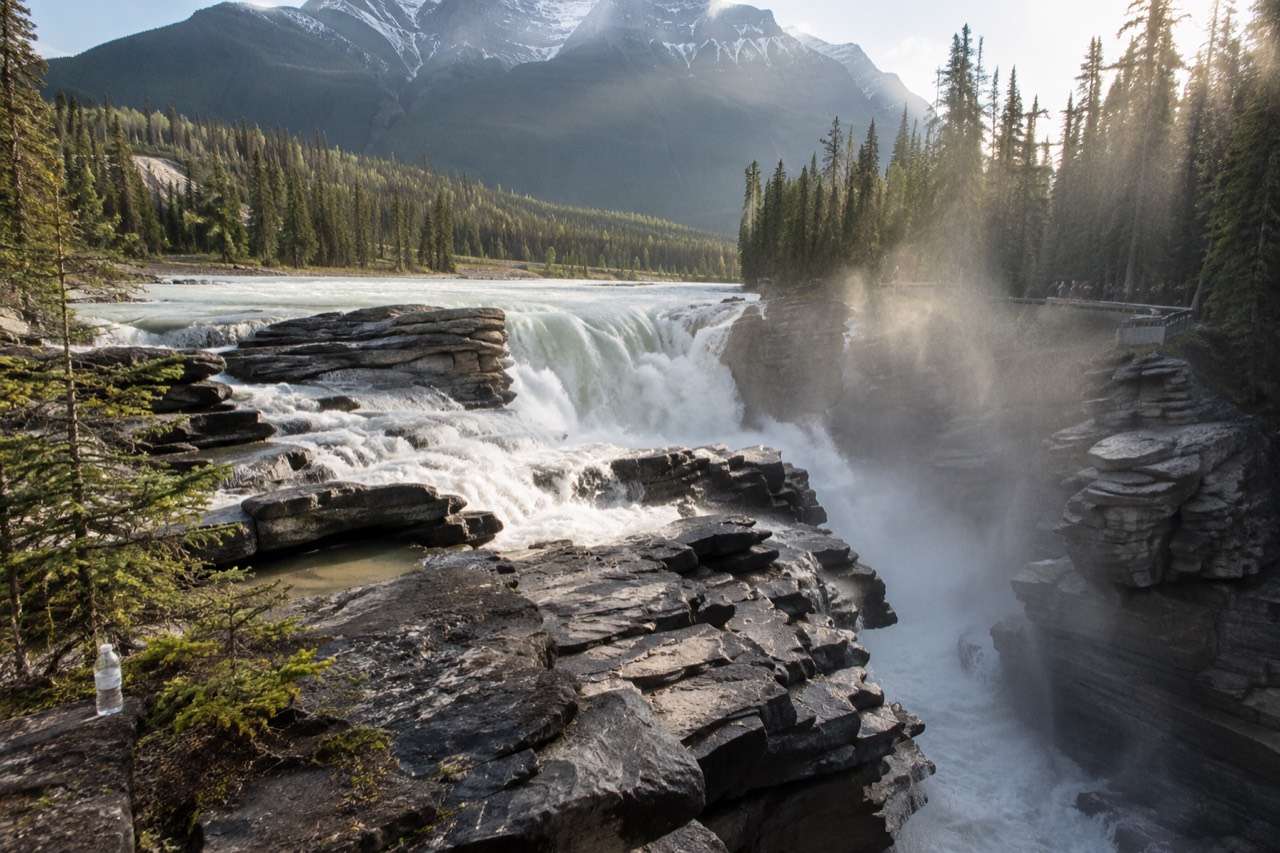
Short answer
Athabasca Falls is 30 km south of Jasper on the Icefields Parkway and Sunwapta Falls is 54 km south. Both are short walk stops rather than hikes: Athabasca Falls is a 23-metre cascade into a carved quartzite canyon, Sunwapta Falls is a stepping waterfall over a hanging valley. Both day-use areas are open and both are standard stops on Icefields Parkway tours.
Athabasca Falls is 23 metres high, which Parks Canada is quick to note is not very tall by Canadian Rockies standards. What makes it the most-visited waterfall in the park is the volume: the Athabasca River, the largest river system in Jasper and a Canadian Heritage River since 1989, forces its entire flow through a gap in hard quartzite, and the soft limestone underneath has been carved into potholes and a short, dramatic canyon. Sunwapta Falls, 24 km further south, is a different animal entirely, a stepping waterfall formed where the smaller hanging Chaba Valley meets the larger Athabasca Valley, dropping into a deep limestone gorge below a footbridge.
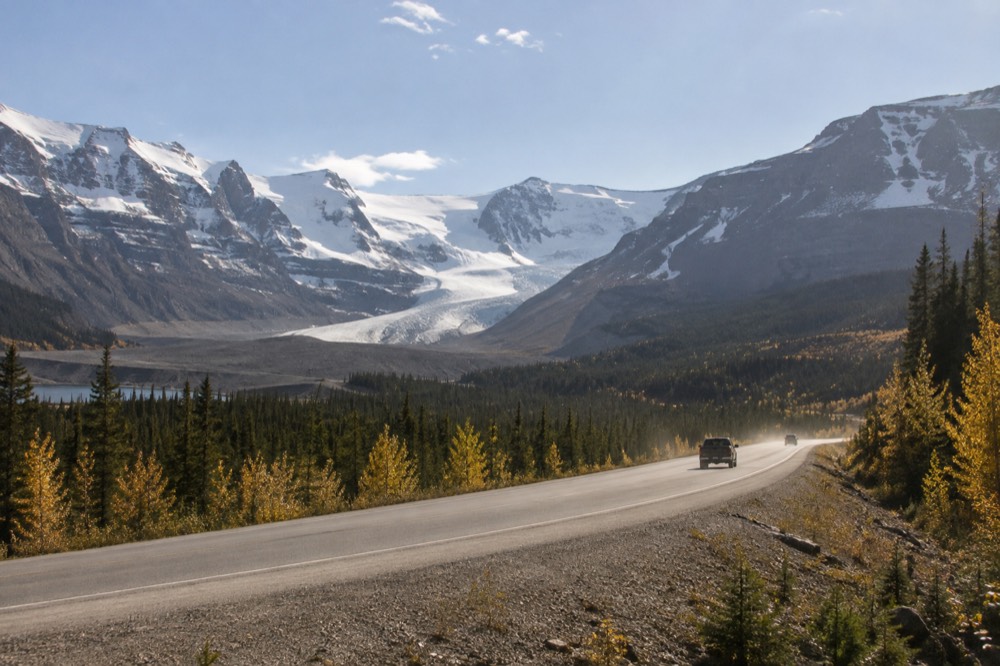
Both falls sit on the Icefields Parkway, the 232 km route between Lake Louise and the Jasper townsite, and both are confirmed stops on several of the tours this site covers. This guide lays out what each stop actually involves, how far each is from Jasper, which tours include them, and what the park pass and the season mean for your plan.
How far is Athabasca Falls from Jasper?
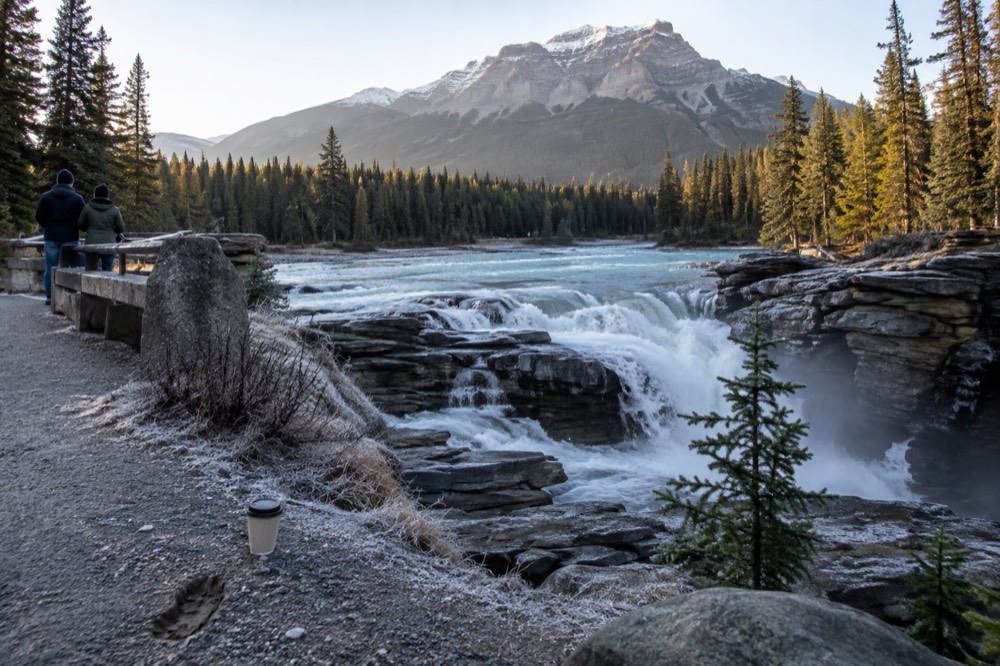
Athabasca Falls is 30 km south of Jasper on the Icefields Parkway, and 203 km from Lake Louise at the other end of the road. It is the closest of the two waterfalls to town, which is why nearly every parkway itinerary and most guided tours put it first. The falls have their own day-use area with a parking lot, and the day-use area and trail are both open.
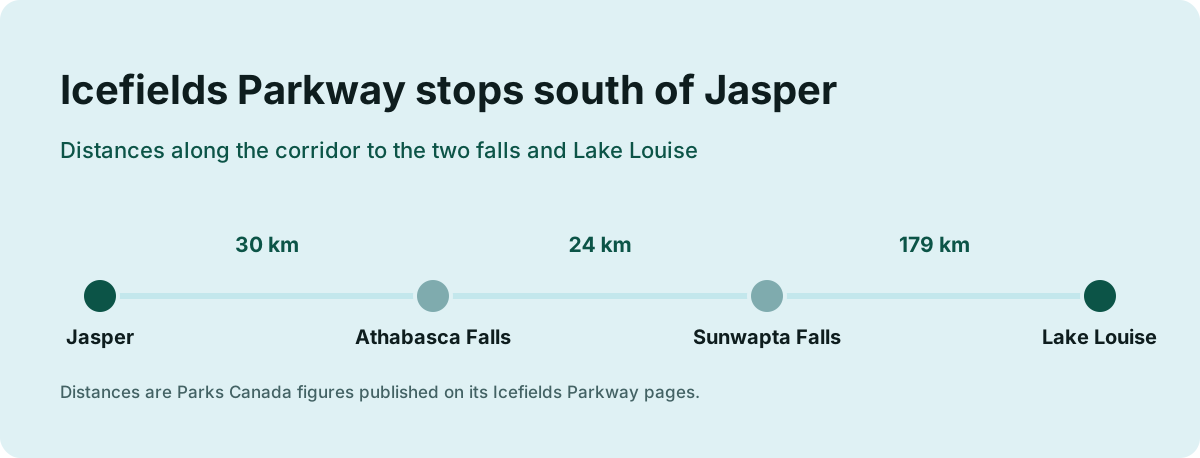
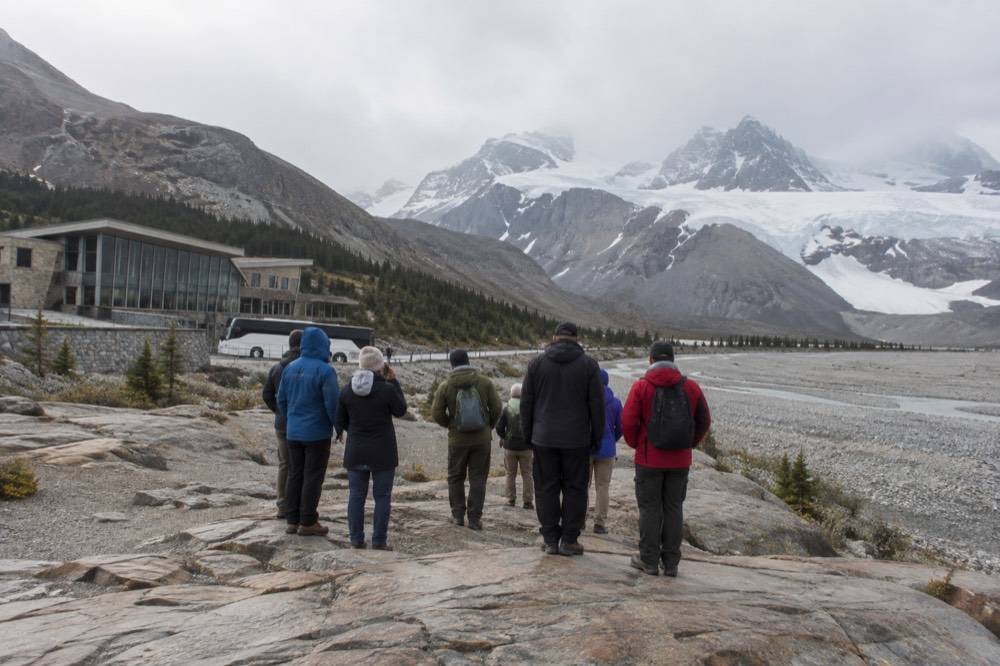
The distance figures are Parks Canada's own, published on its Icefields Parkway pages. The parkway itself runs 232 km end to end, and the Icefield Centre, the building at the Columbia Icefield, is 103 km south of Jasper on Highway 93. That gives you a clean mental map of the corridor: town at zero, Athabasca Falls at 30 km, Sunwapta Falls at 54 km, and the icefield a little past the halfway mark of the drive.
What that means in practice is that Athabasca Falls works as a half-hour stop on almost any southbound plan. It is close enough that you can reach it before the tour buses do, and close enough that it appears on itineraries that have no ambition of driving the whole parkway. If you are planning the full drive, our Icefields Parkway tours guide covers the whole corridor, including the stops further south.
One thing worth knowing before you trust your phone: Parks Canada explicitly warns that navigation apps and web mapping platforms are not always accurate for Jasper National Park. Check 511 Alberta for road conditions and the Parks Canada road restrictions page for seasonal closures before you drive.
What is there to actually see at Athabasca Falls?
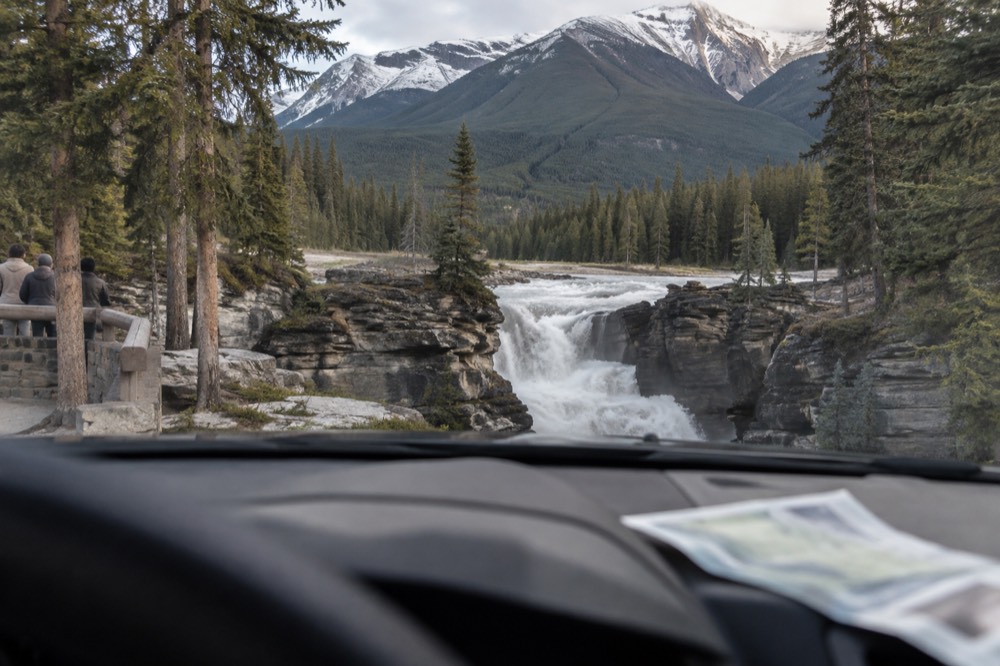
The stop is a short paved walk along a carved canyon, not a hike. A network of paths, bridges and viewing platforms sits above the falls and the gorge below, letting you watch the Athabasca River squeeze through quartzite and pour 23 metres into the canyon it has cut underneath. The rock is the story: hard quartzite on top, softer limestone beneath. Expect railings, spray and crowds, not solitude.
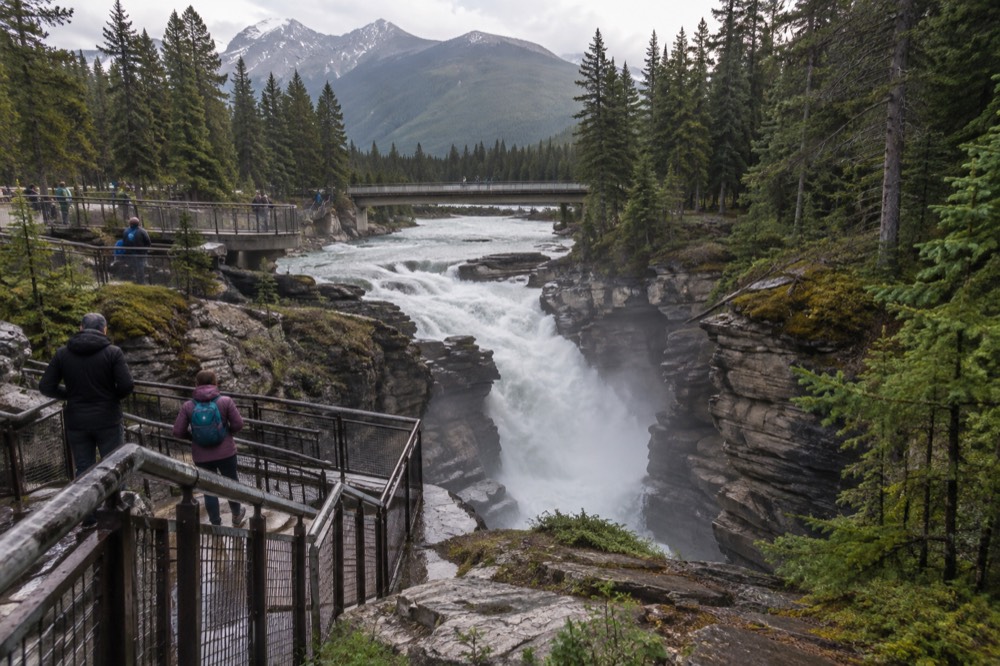
Parks Canada's framing is worth repeating because it calibrates expectations correctly: the falls are "not very high by Canadian Rockies standards, but the size of the river makes it one of the most powerful falls to be found in the mountain national parks." You are not going for a towering curtain of water. You are going to watch a big river compressed into a narrow slot, which is loud, violent and photogenic in a way a tall thin fall is not.
The human history is layered in too. David Thompson travelled the Athabasca River in 1810 and found Athabasca Pass in early January 1811, and the Overlanders followed the river in 1862. Athabasca Pass, one of the park's five National Historic Sites, has a viewpoint about 25 km south on the parkway, so the corridor you are driving is the same one fur-trade and migration routes used.
If you are weighing this stop against everything else in the park, our things to do in Jasper National Park overview puts the falls in context against the lake cruises, the glacier tours and the wildlife drives.
What is Sunwapta Falls and how far is it?
Sunwapta Falls is a stepping waterfall 54 km south of Jasper and 179 km from Lake Louise, formed where the smaller Chaba Valley hangs above the larger Athabasca Valley. The broad U-shaped hanging valleys were carved when glacier ice receded 8,000 years ago, and the falls have cut a deep limestone gorge below the footbridge. Like Athabasca Falls it is a day-use area with a short walk, and both are open.
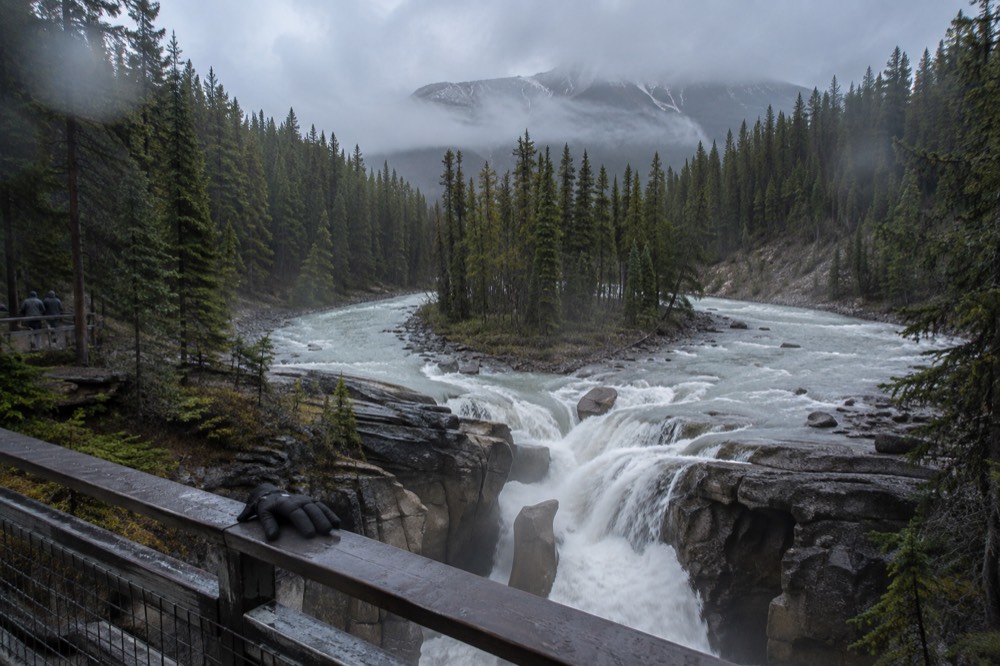
The name of the river is the giveaway about what kind of water you are looking at. Sunwapta is a Stoney word meaning turbulent river, and the falls step rather than plunge: the water drops in stages, splits around rock, and then funnels into the gorge below the footbridge. It is the quieter stop of the two in terms of crowds, partly because it is 24 km further from town.
The walk beyond the falls has a detail most first-time visitors miss. The trail passes through the Chaba River burn area, the legacy of a 1967 wildfire, and Parks Canada now describes it as one of the best bear and moose habitats in the park. A burn from six decades ago reads as mature regrown forest to most eyes, and the wildlife has moved in accordingly. That is a reason to keep your eyes up on this stretch and not just on the water.
Because the falls sit on the parkway, the same driving rules apply as everywhere on this road. There is no cell coverage along much of the route, so download what you need before you leave town.
Can you see both falls on one drive?
Yes, easily. The two falls are 24 km apart on the same road, so a southbound Icefields Parkway drive takes in Athabasca Falls at 30 km and Sunwapta Falls at 54 km with no backtracking. Both are short stops, so the pair together adds roughly an hour and a half to a parkway day including walking and parking. This is why nearly every guided parkway tour lists both.
The corridor stacks up neatly, and the numbers are all Parks Canada's own stop distances:
| Stop | Distance from Jasper | Distance from Lake Louise |
|---|---|---|
| Athabasca Falls | 30 km | 203 km |
| Sunwapta Falls | 54 km | 179 km |
| Icefield Centre (Columbia Icefield) | 103 km | on the 232 km parkway |
| Athabasca Pass viewpoint | about 25 km south of the falls | parkway total 232 km |
If you would rather someone else handle that drive, the 10-hour Jasper to Banff tour runs the full corridor in one day: it is rated 5 across 3 reviews, from $212.2, and its confirmed stops include the Jasper townsite, Athabasca Falls and the Banff townsite, with free cancellation. It is the format to pick when your plan is one-way rather than a loop back to Jasper.
For most visitors, though, the honest question is not whether the drive is possible but whether it is pleasant, and the answer depends on the season. The parkway does not close for the winter, but from 1 November to 31 March vehicles must have snow tires or chains, there are no services along it in winter, and it is not salted, so it is often compact snow. Snow clearing runs 7 am to 3:30 pm. Check conditions before you commit to a winter drive.
Which Jasper tours stop at the falls?
Several confirmed tour routes include one or both falls. The 7-hour guided Columbia Icefield tour from Jasper lists Athabasca Falls among its confirmed stops, alongside the Athabasca Glacier and the Skywalk, and is rated 4.6 across 213 reviews from $248.08. The 10-hour Jasper to Banff day tour also confirms Athabasca Falls. On the Maligne Valley side, two 6-hour valley tours list Sunwapta Falls.
Here is the roster as it stands, using each listing's confirmed stops:
| Tour | Length | Rating | From | Confirmed falls stop |
|---|---|---|---|---|
| 7-Hour Guided Icefield Tour | 7 hours 15 minutes | 4.6 across 213 reviews | $248.08 | Athabasca Falls |
| 10-Hour Jasper to Banff Tour | 10 hours | 5 across 3 reviews | $212.2 | Athabasca Falls |
| 6-Hour Maligne Valley Tour, Spirit Island | 6 hours | 4.7 across 510 reviews | $151.63 | Sunwapta Falls |
| Valley Tour With Guided Walk | 6 hours | 4.7 across 31 reviews | $66.59 | Sunwapta Falls |
The pattern to notice is that the falls are a stop, not a destination. Tours build their day around the glacier or the lake and use the falls as the punctuation marks on the drive, which matches what an independent visitor would do anyway. If you want the falls explained rather than just pointed at, the interpretive options are the ones to look at.
The Ultimate Jasper Nature Walk is one such option: a 3-hour interpretive walk rated 4.6 across 15 reviews, from $63.38, with free cancellation. It will not drive you down the parkway, but it is the format that pairs well with a self-drive falls day, because it teaches you how to read the landscape you will be looking at from the platforms.
Is Athabasca Falls a walk or a pull off?
It is a pull off with a walk attached, and a short one. You park at the day-use area and reach the main viewpoints within minutes on paved paths, with bridges and platforms above the falls and the canyon. There is no trailhead fee, no booking and no long approach. The full loop of paths takes most people well under an hour, which is why tour buses can turn it into a scheduled stop.
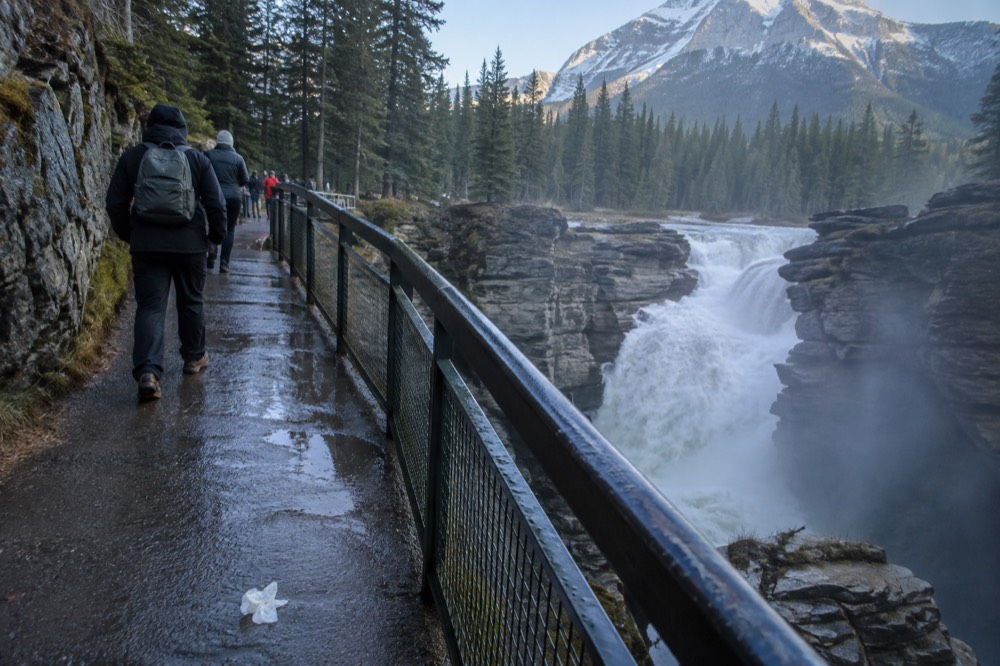
The distinction matters for anyone with limited mobility or limited time, and it matters for tour buyers too. When a tour lists Athabasca Falls as a stop, you now know what that means in practice: a parking lot, a short walk, some railings, spray, and a scheduled window measured in tens of minutes. Nobody on a parkway tour is doing a two-hour canyon hike at this stop.
Sunwapta Falls is the same shape of experience, with one addition worth knowing about: the trail beyond the falls continues into the Chaba River burn area, which is the wildlife habitat mentioned earlier. If your tour gives you free time at the stop, that is the direction the interesting walking goes, and it is also the direction to be bear-aware in.
If you are comparing the two stops as a photographer, the honest summary is that Athabasca Falls gives you power and geology and Sunwapta Falls gives you composition, the split channel and the gorge make for cleaner frames. Both suffer in harsh midday light, which leads to the timing question.
When is the best time to visit the falls?
Morning is the best time at both falls, for three stacking reasons: the light comes from the east and lights the gorge walls, the tour buses tend to arrive from mid-morning onward, and summer afternoon thunderstorms are a real pattern in the valley. July and August are the peak months for water volume, since the rivers run highest with glacier and snowmelt. May and June can push even more water through Athabasca Falls.
The climate record backs up the storm point. Jasper's Canadian Climate Normals for 1991 to 2020 show June, July and August as the wet months, with 57.6 mm, 52.2 mm and 50.8 mm of precipitation respectively, almost all of it falling as rain. July is the warmest month with a daily maximum of 23.4 °C, and the falls corridors stay cool in the gorge shade regardless.
Volume is a genuine seasonal variable, not a marketing one. The Athabasca is fed by glaciers and snowpack, and the same meltwater that fills Medicine Lake in summer keeps both rivers loud from June through August. By late autumn the step structure at Sunwapta is more visible and the water is lower, which some photographers prefer, and the crowds are thinner in the shoulder weeks either side of the peak.
| Month | Daily max °C | Precipitation mm | What it means at the falls |
|---|---|---|---|
| May | 16.4 | 36.5 | High meltwater volume, thin crowds |
| June | 20.0 | 57.6 | Peak volume, peak rain risk |
| July | 23.4 | 52.2 | Warmest and busiest, book tours early |
| August | 23.0 | 50.8 | Busy, afternoon storms possible |
| September | 17.9 | 36.2 | Lower water, thinning crowds, larch colour late in the month |
Our best time to visit Jasper guide works through the same trade-offs for the park as a whole, including the winter side of the calendar.
Do you need a park pass to visit the falls?
Yes, a park pass is legally required to be inside Jasper National Park, and the falls are inside the park. The daily fee is charged per person: $12.25 CAD for adults, $10.75 CAD for seniors, free for youth 17 and under, with a Family/Group rate of $24.50 CAD covering up to seven people in one vehicle. A pass is specifically required to drive the Icefields Parkway.
The Family/Group cap is the number that changes most people's arithmetic. Two adults at $12.25 already equal the $24.50 family rate, so any vehicle with two paying adults or more hits the cap immediately, and the fee behaves like a per-vehicle charge up to seven people. The pass must be printed and displayed prominently on the dash of your vehicle, and it is sold at the park gates, at information centres and campgrounds, and at automated entry pass machines in Jasper.
Two details worth knowing. First, a day pass is valid until 4 pm on the day after purchase and also admits you to Banff, Kootenay, Yoho and the other mountain parks, so it covers a parkway drive that crosses into Banff. Second, whether a guided tour builds the entry fee into its ticket varies by operator: each tour's own inclusions list is the only authority, and this site does not generalise. Parks Canada raises fees periodically, so check the Parks Canada fee page for the current schedule. Our Jasper National Park entry fee guide works through the Discovery Pass break-even in detail.
The falls themselves claim one more safety note, and it is the standard one for this park: stay behind the railings and on the paths. The gorge at Athabasca Falls is carved precisely because the water is powerful enough to cut rock, and the spray zones on the platforms are wet and slick year round.
What about wildlife on the way to the falls?
The drive to both falls is wildlife corridor, and the rules are specific. Stay 30 m away from elk, deer and moose, and 100 m away from bears and other carnivores. Roadside wildlife viewing is a restricted activity year round: stay in your vehicle, pull over only where it is safe, use hazard lights, and move on immediately if a traffic jam develops. The Chaba River burn area beyond Sunwapta Falls is prime bear and moose habitat.
A sighting is never a guarantee on any road or any tour, and no honest page will promise you one. What is verifiable is which animals live here: Parks Canada's list for Jasper includes elk, deer, moose, caribou, bighorn sheep, mountain goats, bears, coyotes, wolves, beavers and more, and bighorn sheep, mountain goats, coyotes and deer are named as commonly sighted along the Icefields Parkway in winter.
If wildlife is the reason you are booking a guided day at all, the Wildlife Tour with Lakeshore Hike is the roster's fit: 4.7 across 391 reviews, from $78.45, 6 hours, with confirmed stops at Patricia Lake, the Maligne Lake boathouse and cruise dock, Medicine Lake and the Whistlers summit. It pairs a guided wildlife drive with a lakeshore walk, and the guides know the viewing rules and the hotspots cold.
Report aggressive wildlife encounters to Parks Canada Dispatch on 780-852-6155, and note that drones are prohibited throughout the park, with fines up to $25,000 CAD. The full species and safety detail is in our Jasper wildlife tours guide.
Which waterfall should you choose if you only have time for one?
Choose Athabasca Falls if you want the powerful, iconic stop and you are short on time, because it is 30 km from town and fits almost any plan. Choose Sunwapta Falls if you have a full parkway day, want thinner crowds and a cleaner photo, and can give the stop a slower hour. If a tour is buying your day, the 7-hour icefield tour includes Athabasca Falls and the Maligne Valley tours include Sunwapta.
The real answer for most readers is that you do not choose, because the two stops are 24 km apart on the same road and cost you nothing but a parking decision. The choice only becomes live when time is genuinely tight, a late arrival day, a single free morning, or a winter day when you want a short outing and no icefield ambitions.
For a one-stop plan, Athabasca Falls wins on three counts: it is closer, it is the more dramatic use of 30 minutes, and its canyon walk is the more varied of the two for a first visit. Sunwapta Falls wins when the visit is about the setting rather than the waterfall, and its burn-area trail gives it the better walking if you are going to linger and the wildlife habitat gives the lingering a purpose.
Whoever is deciding, the falls are the easy part of the corridor. The decisions that actually shape the day are the glacier tour, the cruise and whether you drive or ride, and those are covered across the guides on Jasper National Park Tours.
Common questions about Athabasca Falls and Sunwapta Falls
How far is Athabasca Falls from Jasper?
Athabasca Falls is 30 km south of Jasper on the Icefields Parkway, and 203 km from Lake Louise. Sunwapta Falls is 54 km from Jasper, 24 km further along the same road.
Is Athabasca Falls a hike or a quick stop?
It is a quick stop with a short paved walk attached. The main viewpoints and bridges above the falls and canyon are minutes from the day-use parking area, and most visitors spend well under an hour on the paths.
Can you see both Athabasca Falls and Sunwapta Falls in one day?
Yes. The two are 24 km apart on the same road, so a southbound Icefields Parkway drive takes in both with no backtracking, and the pair adds roughly an hour and a half to a parkway day including walking and parking.
Do you need a park pass to visit the falls?
Yes. A park pass is legally required to be inside Jasper National Park, and a pass is specifically required to drive the Icefields Parkway. The Family/Group daily rate of $24.50 CAD covers up to seven people in one vehicle.
Which Jasper tours stop at Athabasca Falls?
The 7-hour guided Columbia Icefield tour from Jasper and the 10-hour Jasper to Banff day tour both list Athabasca Falls among their confirmed stops. Two 6-hour Maligne Valley tours list Sunwapta Falls.
When is the best time of day to visit the falls?
Morning, for light, for water volume in summer and for beating the tour buses, which tend to arrive from mid-morning onward. July and August bring the highest meltwater volumes along with the biggest crowds.