Do I Need Bear Spray In Jasper National Park?
Parks Canada tells Jasper hikers to carry bear spray and know how to use it. Here is what that means in practice, where bears actually live in the park, and how a guided tour fits in.
Do I Need Bear Spray In Jasper National Park?
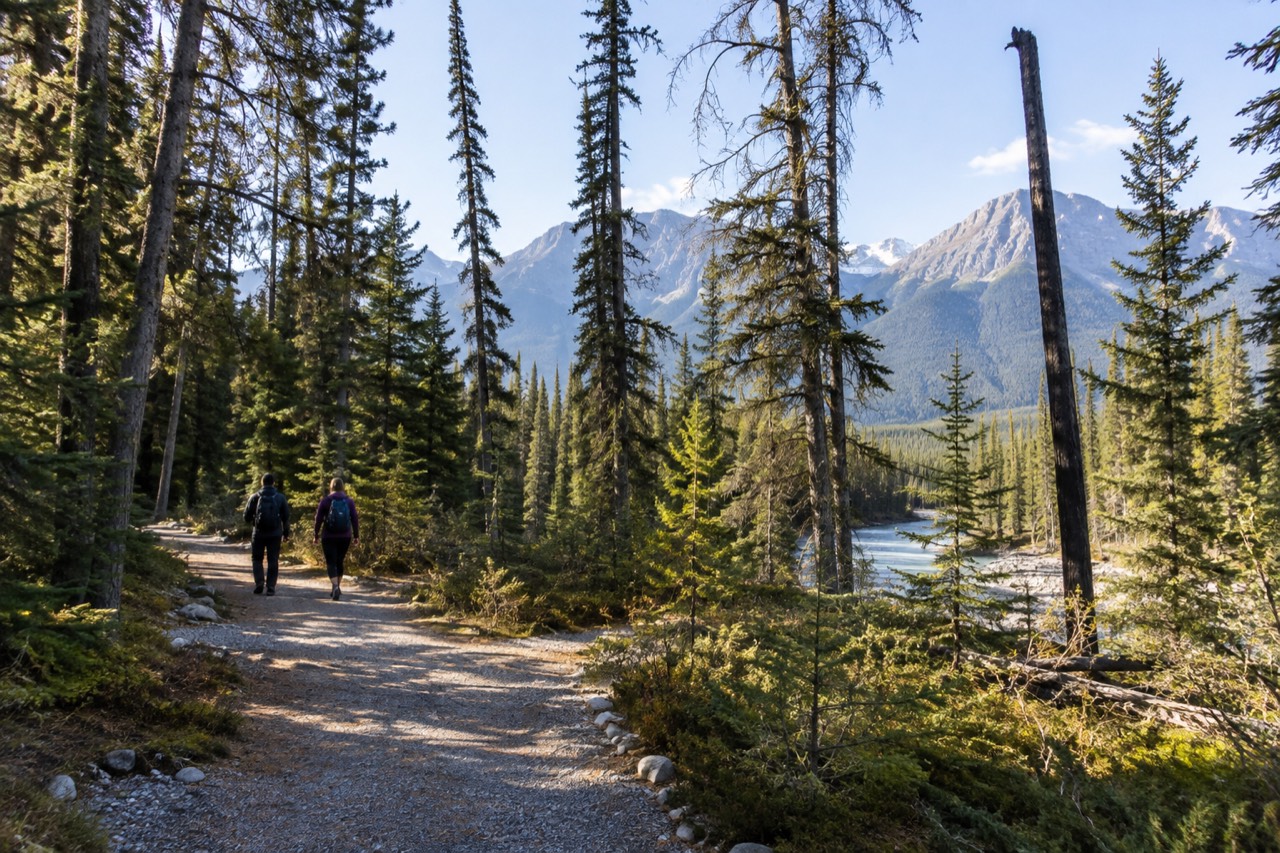
Yes, you should carry bear spray in Jasper National Park. Parks Canada's standing safety guidance tells trail users to carry it and know how to use it, and since both black bears and grizzly bears live in the park, that instruction applies on every trail in every season. The guidance does not claim every visitor needs it for every activity, and the sections below separate those two cases honestly.
That is the whole answer in one line, but the details decide what you actually do on the morning of your hike. Jasper National Park spans 11,228 square kilometres, making it the largest and most northerly of the Canadian Rocky Mountain national parks, and its mammal list, in Parks Canada's own words, includes elk, deer, moose, caribou, bighorn sheep, mountain goats, bears, coyotes, wolves, beavers, pine martens, lynx, porcupines, cougars, snowshoe hares and wolverines. "Bears" in that list means both black bears and grizzlies. The park's management plan notes that roughly 97 percent of the park is maintained in a natural state with limited infrastructure, which is a polite way of saying most of it is bear country.
The distinction worth making is between the townsite and the backcountry. Walking Connaught Drive, or standing at the Athabasca Falls viewpoint rail with a crowd, is a different risk situation from walking the Valley of the Five Lakes trail alone at dawn with headphones in. Parks Canada's guidance is written for the second situation. The Jasper National Park Tours site covers both, and this page is about the trails.
If you would rather have a guide who carries the spray, makes the noise calls and reads the valley for you, the guided options below are the natural fit. The snowshoe tour runs in winter, the lakeshore hike version runs as a wildlife and sightseeing tour with a walk, and the cruise pairing puts a naturalist between you and the Maligne Valley.
Where do bears actually live in Jasper?
Jasper's bears are spread across the park rather than fenced into one corner, and Parks Canada names specific places where bear and moose habitat sits right beside popular trails. The open lodgepole pine and spruce forest at the north end of Maligne Lake is named moose and Harlequin Duck habitat, and the Chaba River burn area beyond Sunwapta Falls is described as one of the best bear and moose habitats in the park.
The Chaba River burn is the detail most first-time visitors miss. The trail beyond Sunwapta Falls, 54 km from Jasper on the Icefields Parkway, passes through forest that burned in 1967 and has spent nearly six decades regrowing into browse-heavy habitat. Parks Canada says it plainly: it is now one of the best bear and moose habitats in the park. So a short, family-friendly walk to a famous waterfall sits at the edge of prime bear country, and that is exactly the kind of place where carrying spray and making noise earns its keep.
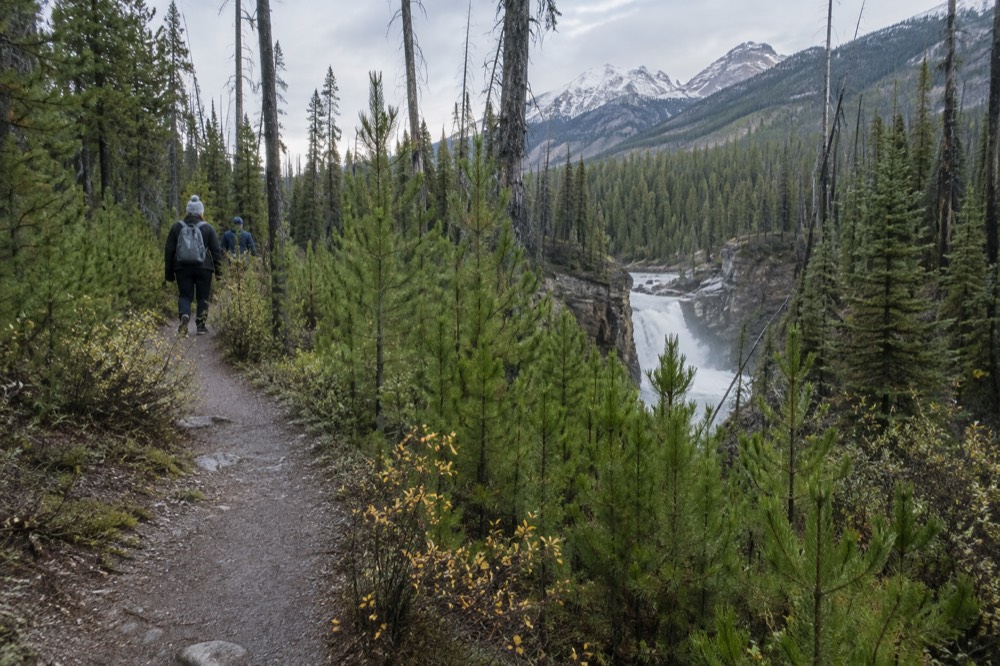
The 2024 wildfire changed some of this map. The Jasper Wildfire Complex burned 32,722 hectares, running north up the Athabasca valley south of town, reaching the townsite's southwest edge and burning in the Maligne Valley. Parks Canada describes fire-damaged slopes in steep terrain remaining unstable for years and hazard trees staying unstable for several years after a fire. Regrowth is under way, with whitebark pine restoration planting in the burned areas, and regenerating burned ground is attractive browse. The practical reading: burned and regrowing valleys near trails are productive wildlife habitat, and the official word on where you can walk is the Parks Canada trail conditions page, not a map app.
One thing this page will not do is promise you a bear. No sighting in Jasper is ever a guarantee, and no tour listing can honestly make one either. What the facts support is that the habitat is real, the animals are present across the park, and your preparation should assume an encounter is possible on any trail.
What are the official wildlife rules in Jasper?
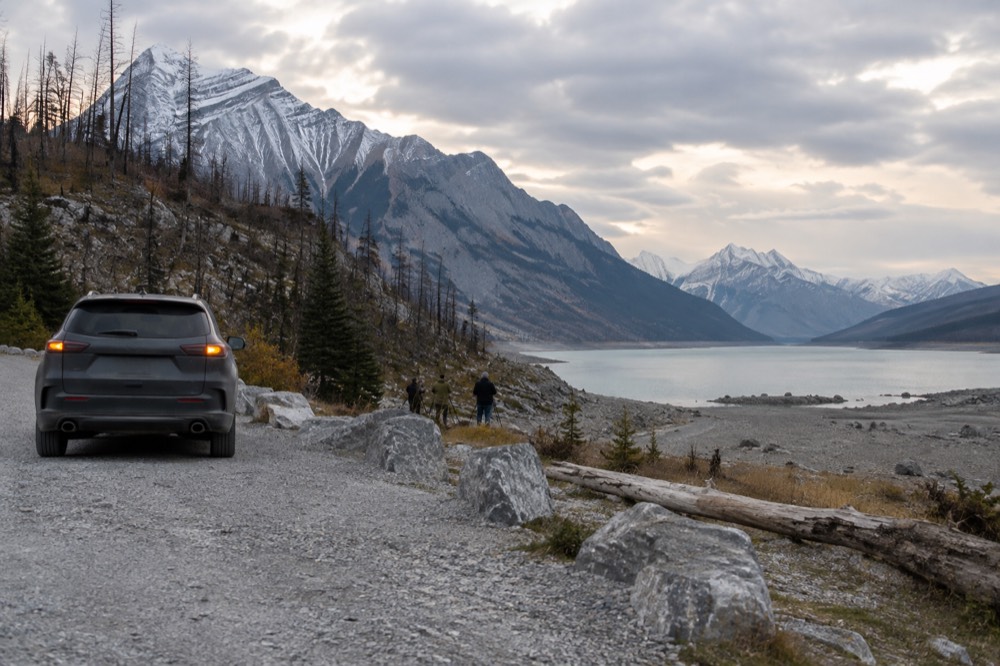
Parks Canada sets two distances that apply to every visitor: stay 30 m, three bus lengths, away from elk, deer and moose, and stay 100 m, ten bus lengths, away from bears and other carnivores. Roadside wildlife viewing is a designated restricted activity year round, with specific rules about how to stop. On the trails, the standing guidance is to travel in groups, make noise, remove headphones and carry bear spray and know how to use it.
The roadside rules deserve their own paragraph because they are legally framed, not suggestions. When you spot an animal from the road: stay in your vehicle, slow down and obey speed limits, use hazard lights, and pull over only where it is safe, never in a driving lane. Observe, photograph and move on, and move on immediately if a traffic jam develops. It is an offence to entice, pet, harass or feed wild animals in the park, and pursuing an animal with a camera counts as harassment. If a meeting on foot goes wrong, aggressive wildlife encounters are reported to Parks Canada Dispatch on 780-852-6155.
Here is the rule set in one table, exactly as Parks Canada publishes it:
| Situation | What Parks Canada requires |
|---|---|
| Elk, deer or moose nearby | Stay 30 m away, three bus lengths |
| Bear or other carnivore nearby | Stay 100 m away, ten bus lengths |
| Wildlife seen from the road | Stay in your vehicle, use hazard lights, pull over only where safe, never stop in a driving lane, observe and move on |
| Traffic jam developing at a roadside sighting | Move on immediately |
| Any wild animal | Never entice, pet, harass or feed; pursuing with a camera counts as harassment |
| Meeting wildlife on a trail | Back away and return the way you came |
| Aggressive encounter | Report to Parks Canada Dispatch, 780-852-6155 |
| Flying a drone anywhere in the park | Prohibited, fines up to $25,000 CAD |
Bear spray sits inside this framework as the tool of last resort, and Parks Canada pairs it with behaviour, not as a substitute for it. The noise, the group, the removed headphones and the willingness to turn back are the primary defences. The spray is what you carry for the rare case where distance and awareness were not enough.
A guided tour puts a trained person in charge of all of this at once. The wildlife and sightseeing tour with lakeshore hike, 4.7 across 391 reviews and from $78.45, walks Patricia Lake and the Maligne Valley with a guide who manages the distances and the roadside etiquette for the group.
If the winter version of the question is the one you are actually asking, the snowshoe option below answers it directly: a guide who knows the valley, hotel pickup, and a free-cancellation window if the day turns.
Which trails are open, and where should you not go?
Most of Jasper's trail network is open again. Parks Canada states that virtually all of Jasper's trails have reopened since the 2024 wildfire, and the live register lists open trails including Valley of the Five Lakes, Old Fort Point, Wabasso Lake, The Whistlers, Sulphur Skyline, Wilcox Pass, Athabasca Falls, Sunwapta Falls, Maligne Lake, Bald Hills and Opal Hills. The two hard exceptions are the Edith Cavell area trails and Maligne Canyon, both closed for the 2026 season.
The closures matter for this question because both are places people used to walk. Cavell Road is closed and prohibited to all travel, and with it the trails in the Edith Cavell area, including trail 41 Path of the Glacier and trail 42 Cavell Meadows. Maligne Canyon is closed from the First Bridge parking lot to the Fifth Bridge junction, and winter access to the canyon for winter recreation is prohibited as well. Parks Canada's reason is slope stability: the loss of trees and vegetation raises debris-flow and landslide risk, and the opening date will be set only once the work is finished. Do not plan around either, and check the official What's Open register before you lace up.
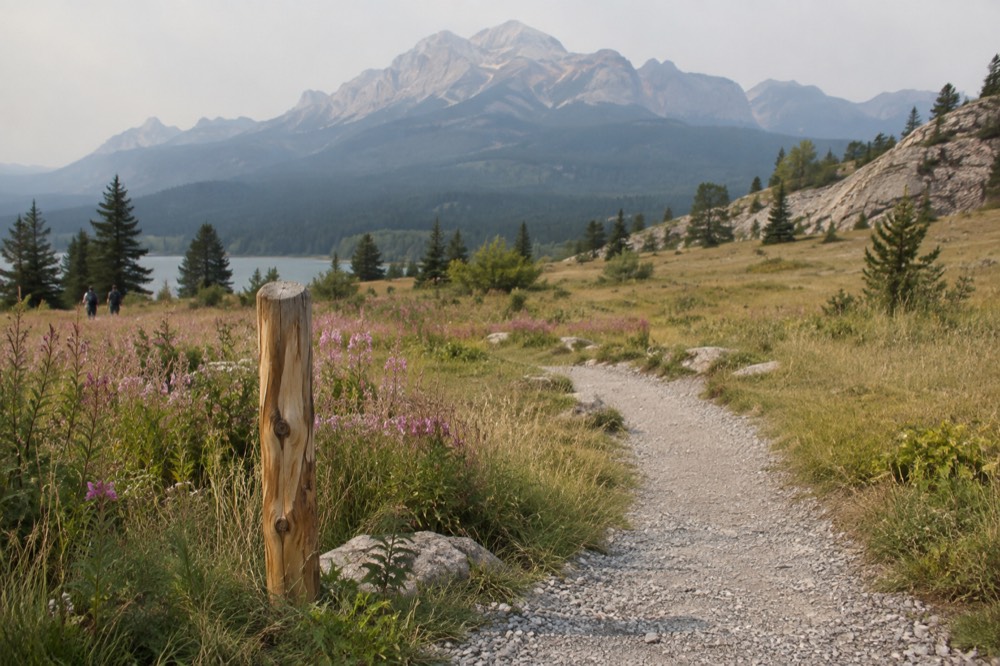
For the trails that are open, the bear-spray question scales with how many people share the path with you. Valley of the Five Lakes reopened in summer 2026 after realignment and resurfacing, and more than 800 visitors walked it on opening day, which is a very different crowd level from the Tonquin Valley via Portal Creek. Busy frontcountry trails carry noise and human presence with them; quiet ones do not. That is the honest calculus, and it is why the same guidance covers both. Everything else covered here is indexed on Jasper National Park Tours.
Does a guided tour replace carrying bear spray?
A guide replaces your judgement calls, not the park's rules. On a guided wildlife or snowshoe tour the guide carries the spray, makes the noise, reads the tracks and decides when to turn the group around, and that is a legitimate way to meet the safety guidance without buying a canister you will fly home without. On a self-guided trail walk, the guidance is addressed to you personally, and there is no guide to delegate it to.
The distinction is practical, not pedantic. A visitor flying into Edmonton, driving 370 km west to Jasper and walking one popular trail has a genuine reason to not own a canister of bear spray, and choosing a guided walk is the clean answer. The Secrets of Jasper Snowshoe Tour, from $65.08 for about 3 hours with hotel pickup and free cancellation, is built for exactly that traveller: a guide handles the winter trail decisions while you learn the valley. It has no rating yet, which simply reflects a newer listing rather than a verdict on quality.
The same logic covers the summer wildlife tours. The wildlife and sightseeing tour with the Maligne cruise, 4.8 across 665 reviews and from $169.04 for 6 hours, adds hotel pickup and free cancellation and pairs the Maligne Valley drive with the Spirit Island cruise. You can read more about the valley's wildlife in our guide to Jasper wildlife tour options, and about where animals actually show up in our piece on the best wildlife viewing spots in Jasper.
One caution to carry with the convenience: whether a tour's ticket includes your park entry is an operator-by-operator decision. Parks Canada charges a commercial group rate per person for tours, and each operator's own inclusions list is the only authority for that tour. A park pass is legally required to be inside Jasper National Park, the daily fee is charged per person with a Family/Group cap of $24.50 CAD covering up to seven people in one vehicle, and the current figures live on the Parks Canada fee page.
What else should you know before walking a Jasper trail?
Three things round out the picture. Jasper is a Dark-Sky Preserve, the second largest in the world at over 11,000 square kilometres, so shoulder-season walks start and end in the dark. Winter here is real, with 41 days per year of wind chill below -20 °C concentrated in December, January and February. And the park's wildlife guidance asks you to back away and return the way you came if you meet an animal on a trail.
The dark-sky point sounds like a stargazing fact until you are on a trailhead at 7 am in October with a headlamp and a can of spray on your belt. The Royal Astronomical Society of Canada designated Jasper a Dark-Sky Preserve in March 2011, and the darkness that makes the October Dark-Sky Festival possible is the same darkness that makes dawn and dusk trail walks quiet ones. Those are also the hours wildlife moves.
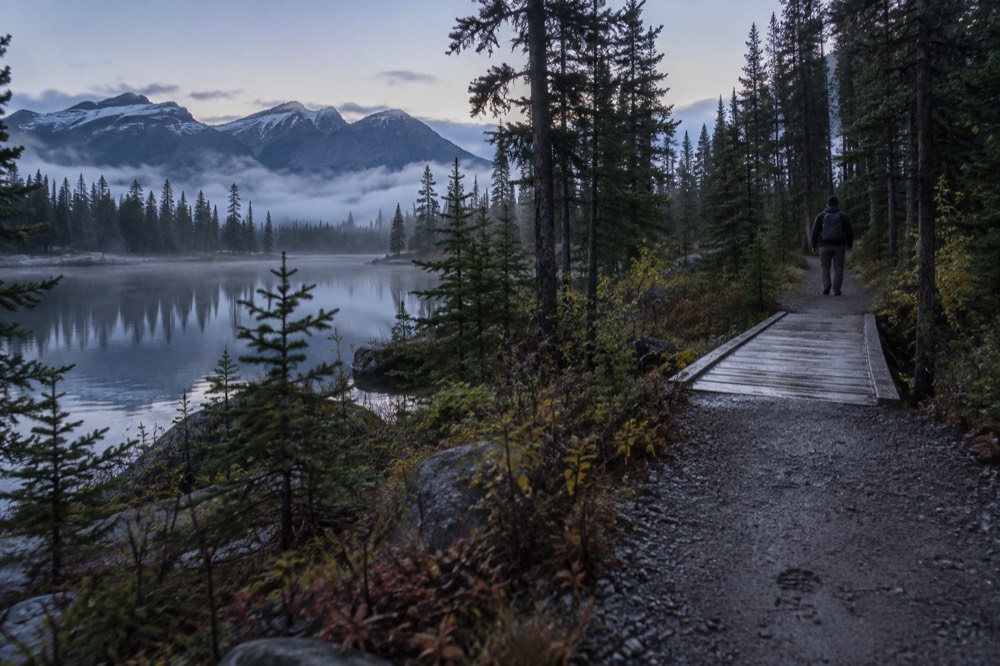
The weather shapes the season more than most visitors expect. July and August, Jasper's warmest months, average daily highs of 23.4 °C and 23.0 °C respectively, while January's average daily low is -14.4 °C. June, July and August are also the wettest months, with 57.6, 52.2 and 50.8 mm of precipitation. A wet July morning on a quiet trail is a morning where you want both the spray and the group the guidance asks for, and our guide to the best time to visit Jasper works through the full seasonal trade-offs.
Finally, the honest summary of this whole question. Bear spray in Jasper is not a legal requirement the way a park pass is; it is Parks Canada's standing safety instruction for anyone walking trails in bear country, and Jasper is bear country end to end. If you walk the popular trails on your own, carry it and know how to use it. If you walk with a guide, the guide carries that responsibility. What you should never do is treat the townsite's comfort as a proxy for the whole park, because the park is 11,228 square kilometres and the bears do not read the trailhead signs.
If a guided walk is how you want to meet the valley, these three are the natural shortlist for the wildlife-minded visitor.
Common questions about bear spray in Jasper National Park
Do I Need Bear Spray In Jasper National Park?
Parks Canada's standing guidance for Jasper's trails is to carry bear spray and know how to use it, alongside travelling in groups, making noise and removing headphones. It is a safety instruction rather than a legal requirement like the park pass, but both black bears and grizzlies live throughout the park, so any trail walk should treat it as necessary.
Where can I see bears in Jasper National Park?
There is no guaranteed viewing spot, and no honest source will promise a sighting. What Parks Canada does confirm is that the Chaba River burn area beyond Sunwapta Falls is one of the best bear and moose habitats in the park, and that bighorn sheep, mountain goats, coyotes and deer are commonly sighted along the Icefields Parkway in winter. Roadside viewing is a restricted activity with strict rules on where you may stop.
How close can I get to a bear in Jasper?
Stay 100 m away, ten bus lengths, from bears and other carnivores. For elk, deer and moose the distance is 30 m, three bus lengths. If you meet wildlife on a trail, back away and return the way you came, and report aggressive encounters to Parks Canada Dispatch on 780-852-6155.
Do guided Jasper tours carry bear spray for you?
On guided wildlife, snowshoe and hiking tours the guide manages wildlife safety for the group, including carrying spray and deciding when to turn back. Whether any individual tour includes your park entry fee is an operator-by-operator decision, so check each tour's own inclusions list before you book.
Are Jasper's trails open after the 2024 wildfire?
Virtually all of Jasper's trails have reopened since the 2024 wildfire, including Valley of the Five Lakes, Old Fort Point, Wabasso Lake and Sulphur Skyline. The two exceptions are the Edith Cavell area trails and Maligne Canyon, both closed for the 2026 season with no reopening date set. Check the official What's Open register before you plan a walk.