Free Things To Do In Jasper National Park: The Honest List
Free in Jasper is a bigger list than most visitors expect, but it starts with one honest caveat: the park pass is not optional, and everything free sits on the far side of that fee.
Short answer
Jasper National Park has a long list of experiences that cost nothing beyond the daily park pass: Athabasca Falls, Sunwapta Falls, Medicine Lake, the Valley of the Five Lakes trail, Pyramid Beach, Old Fort Point and the night sky over the second largest dark-sky preserve in the world. Entry itself is not free: adult admission is $12.25 CAD per day, youth 17 and under enter free.
What Is Genuinely Free In Jasper National Park?
Yes, everything listed here is genuinely free once you hold a park pass: Athabasca Falls and Sunwapta Falls day-use areas, Medicine Lake, the Valley of the Five Lakes trail, Old Fort Point, Pyramid Beach and Pyramid Island, Patricia, Annette and Edith lakes, the Jasper Information Centre, and the night sky above all of it. None carries a separate ticket, though none waives the park entry fee, which is a separate cost entirely.
That distinction is the spine of this page, so it gets stated once, plainly, at the top. Jasper National Park was established in 1907 and spans 11,228 square kilometres, making it the largest and most northerly of the Canadian Rocky Mountain national parks. Roughly 97 percent of it is maintained in a natural state with limited infrastructure, which is a roundabout way of saying that most of the park is, structurally, free terrain. The developed attractions, the ones with parking lots and boardwalks and interpretive signs, are mostly free to walk onto. The ones with boats, buses, gondolas and guides are not.
There is also a closed category that older guides still recommend, and pretending it is open would be the dishonest kind of helpful. Maligne Canyon is closed from the First Bridge parking lot to the Fifth Bridge junction, including winter access for winter recreation, and Cavell Road is closed and prohibited to all travel, with the Path of the Glacier and Cavell Meadows trails closed with it. Parks Canada says both will remain closed for the 2026 season, because the loss of trees on high-angle slopes raises the risk of debris flows and landslides. Entering a closed area carries a maximum penalty of $25,000 CAD under the Canada National Parks Act. Neither appears on the free list below, and neither should appear on anyone's itinerary this year. If you are weighing a trip around the canyon, the question of why Maligne Canyon is closed is covered in full elsewhere on this site.
What follows is the honest ledger. The free list is long and genuinely good. Then it stops, at a glacier and an island, and this page names exactly where.
Do You Still Have To Pay To Enter The Park?
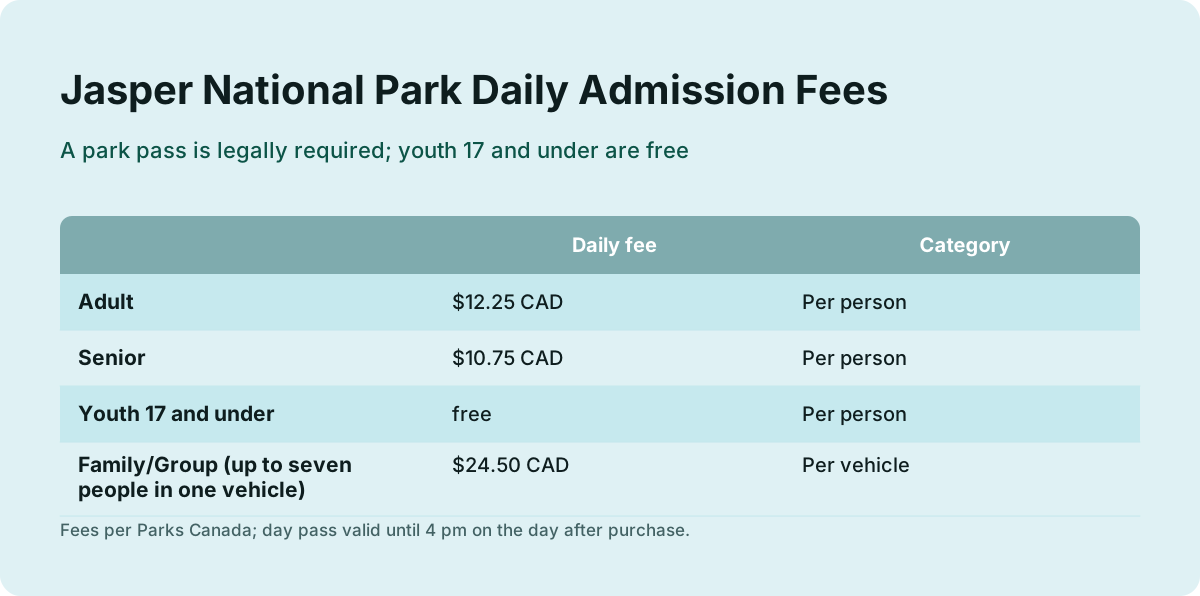
Yes. A park pass is legally required to be inside Jasper National Park, and the free-entry window that older pages describe has closed. Daily admission is charged per person: adult $12.25 CAD, senior $10.75 CAD, youth 17 and under free, with a Family/Group daily rate of $24.50 CAD covering up to seven people arriving in one vehicle. Two paying adults already reach that cap, so most travelling groups pay the family rate.
The Canada Strong Pass, which gave free admission to Parks Canada places, ended on 7 September 2026, and regular fees apply again. Any page that tells you entry to Jasper is currently free is describing a window that shut, and there is a whole cluster of stale advice online doing exactly that. The fee is charged per person, but the Family/Group cap makes it behave like a per-vehicle charge for any group of two or more paying adults, since two adults at $12.25 already equal the $24.50 family rate. All figures here are Canadian dollars, which matters, because a large share of Jasper's visitors are American and the numbers otherwise read as smaller than they are.
A day pass is valid until 4 pm on the day after purchase and admits the holder to Jasper, Banff, Kootenay, Yoho, Mount Revelstoke, Glacier, Waterton Lakes and Elk Island national parks, though not to national historic sites. If your plans involve more than one mountain park, that detail quietly changes the arithmetic. The full fee schedule, including the Discovery Pass at $83.50 CAD for an adult year, is on the Parks Canada fee page, and Parks Canada raises these figures annually, so check the page rather than any third-party number, including one printed here.
One thing Jasper does not have, and this is worth knowing before you over-plan: there is no timed entry system, no reserved-access corridor and no mandatory shuttle for any attraction. The only authorization required to travel anywhere in the park is the park pass itself. If you have read about reservation systems at other Rockies lakes and are bracing for a booking maze, Jasper does not have one. That is a real difference, and it makes the free list below considerably easier to act on: you drive where you like, when you like, pass on the dash.
For the wider picture of what a Jasper trip costs once tours enter the equation, the site's guide to what Jasper tours cost breaks the paid side down. For now, the short version is that the pass is the only mandatory fee in this entire article.
Which Roadside Stops Cost Nothing Beyond The Park Pass?
The open, free roadside stops are Athabasca Falls, 30 km from Jasper on the Icefields Parkway; Sunwapta Falls, 54 km from Jasper; Medicine Lake on the Maligne Lake Road; the Maligne Lake boathouse picnic site; Pyramid Beach, Pyramid Island, Patricia Lake, Annette Lake, Edith Lake and Sixth Bridge. Every one of these is a drive-up day-use area with no separate ticket, open per the park's current register.
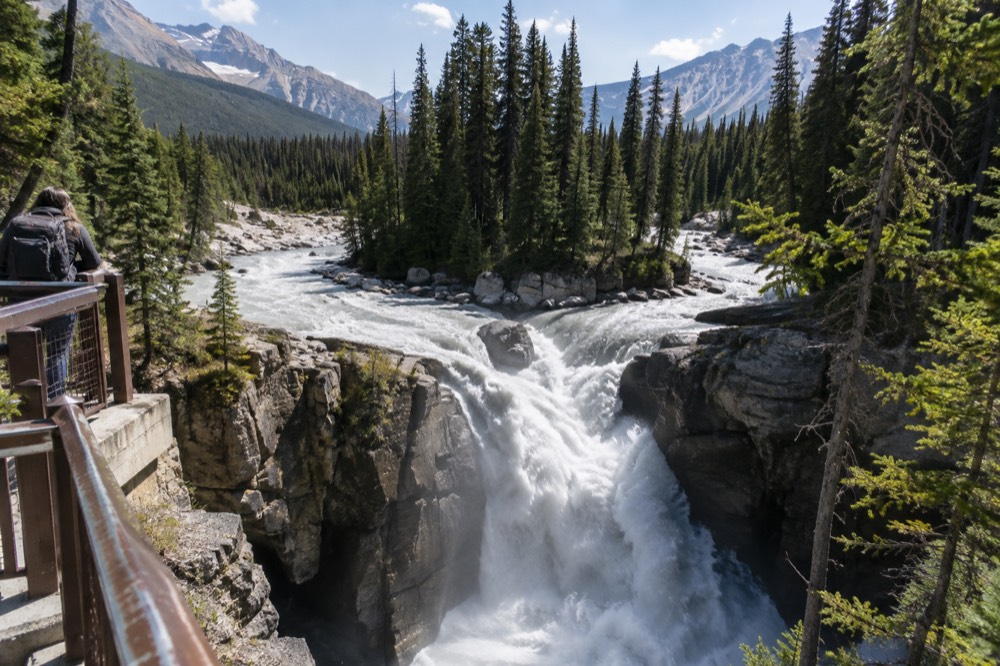
Athabasca Falls is the headline stop and it earns it honestly. The falls drop 23 metres, which Parks Canada itself notes is not very high by Canadian Rockies standards, but the size of the river makes it one of the most powerful falls in the mountain national parks. The water pours over hard quartzite and has cut into the softer limestone beneath, carving potholes and a short canyon you can walk along on a developed trail. It is 30 km from Jasper and 203 km from Lake Louise, so it works as either a short detour or an Icefields Parkway stop.
Sunwapta Falls, 54 km from Jasper, is a stepping waterfall formed where the smaller hanging Chaba Valley meets the larger Athabasca Valley. Those broad U-shaped hanging valleys were formed when glacier ice receded 8,000 years ago, and the falls have carved a deep limestone gorge below the footbridge. The trail beyond the falls passes through the Chaba River burn area, the legacy of a 1967 wildfire, which is now one of the best bear and moose habitats in the park. That detail is a nice piece of perspective two years after Jasper's own fire: burned forest becomes habitat, and habitat becomes wildlife.
Medicine Lake is the strange one, and the one most visitors misread. It has no visible outflow. The Maligne River pours in from the south and drains out through sinkholes in the lake bed, running through a limestone cave system and surfacing again near Maligne Canyon, 16 kilometres downstream. In summer, glacial meltwater exceeds the sinkholes' capacity and the lake fills. In autumn and winter the sinkholes drain it faster than the river fills it, and the lake becomes a mudflat with scattered pools. Parks Canada calls it one of the largest known sinking rivers in the Western Hemisphere, and states that this drainage system was part of why the Rocky Mountain Parks World Heritage Site was created. Arrive in July and arrive in October and you will see two different lakes.
| Free roadside stop | Distance from Jasper | What it is |
|---|---|---|
| Athabasca Falls | 30 km | 23 m falls over quartzite, potholes and a short canyon trail |
| Sunwapta Falls | 54 km | Stepping waterfall above a limestone gorge, footbridge viewpoint |
| Medicine Lake | Maligne Lake Road | Sinking lake, filled in summer, mudflat by late autumn |
| Maligne Lake boathouse picnic site | End of Maligne Lake Road | Picnic site at the north end of the lake |
| Pyramid Beach and Pyramid Island | Short drive from town | Lakeshore day-use area with mountain views |
| Patricia, Annette and Edith lakes | Short drive from town | Three lakeside day-use areas |
| Sixth Bridge | Maligne Valley | Day-use area on the Maligne River |
The live word on which of these is open on any given day belongs to Parks Canada's What's Open register, which lists every open day-use area and trail. The list above reflects that register; treat the register, not this page, as the thing to check the morning you drive. The Icefields Parkway itself, the 232 km road connecting Lake Louise with the Jasper townsite, has no seasonal closure, and a park pass is required to drive it.
For readers planning the drive rather than the stops, the site's guide to Icefields Parkway tours covers the route in full, including the two falls above.
Which Free Trails Are Open Again After The Wildfire?
The open free trails include Valley of the Five Lakes, Old Fort Point, Wabasso Lake, The Whistlers, Whistlers Summit, Toe of the Glacier, Wilcox Pass, Sulphur Skyline, both ends of the Skyline, Athabasca Falls, Sunwapta Falls, Maligne Lake, Bald Hills and Opal Hills. Parks Canada's own summary is that virtually all of Jasper's trails have now reopened since the 2024 wildfire, and the majority of the park is open and ready to explore.
The Valley of the Five Lakes trail is the emblem of that recovery. It reopened in summer 2026 after realignment, resurfacing, new signage and new rest areas, and more than 800 visitors walked it on opening day. Wabasso Lake trail and the Curator trail also reopened in summer 2026, and Trail 9 reopened with about a kilometre rerouted onto the ridge and rebuilt switchbacks. If you read older coverage describing Jasper's trail network as gutted by the fire, that was true for a while and is no longer the picture: the reopened list is now the long list.
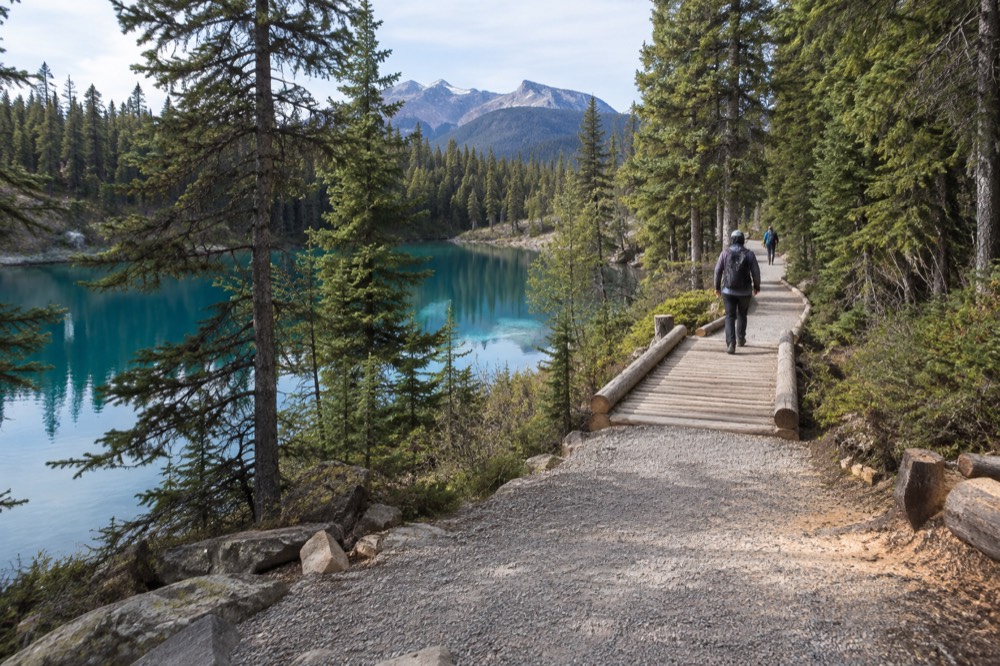
Two trail names on that list deserve a flag before you lace up. The Whistlers and Whistlers Summit trails are open, and they connect to a genuinely free summit experience: the trail from the SkyTram's upper station climbs to 2,463 metres, and you can hike the whole mountain from the bottom without a ticket if your legs are willing. The Toe of the Glacier and Wilcox Pass trails are open, and both give you glacier views without stepping on ice, which matters later on this page. The Sulphur Skyline trail is a steady climb to a panoramic ridge near Miette Hot Springs, and the hot springs at the bottom are the paid part, not the trail.
| Open free trail | Character | What to know |
|---|---|---|
| Valley of the Five Lakes | Five small turquoise lakes, resurfaced trail | Reopened in summer 2026 after rebuilding |
| Old Fort Point | Short climb above the Athabasca, town views | Closest open summit walk to town |
| Toe of the Glacier | Walk to the Athabasca Glacier terminus | Viewing only, never walk on the ice |
| Wilcox Pass | Alpine pass trail opposite the icefield | Glacier panorama without a glacier ticket |
| Sulphur Skyline | Ridge climb near Miette Hot Springs | Trail is free, the springs are not |
| The Whistlers and Whistlers Summit | Climb from valley to 2,463 m | Free alternative to the SkyTram ride |
| Skyline, both ends | Access to Jasper's famous backcountry route | Day sections need no booking |
What the fire still closes is smaller but specific: trail 9c, a section of trail 7 behind the golf course, trail 5b, the Tonquin Valley via the Astoria River, and the area around the Maligne Horse Range. The full closure picture, including the canyon and Cavell Road discussed earlier, sits on Parks Canada's park recovery page. For the state of the town and the wider visit, the site's guide to whether Jasper is open after the wildfire takes that question in full.
The honest note on what you will see: the burn is visible along the Athabasca valley south of town, around the townsite's southwest edge and up the Maligne road corridor. Regrowth is under way, including whitebark pine restoration planting, and Parks Canada describes a regenerating landscape along the reopened Valley of the Five Lakes trail. Write that into your expectations now, so the drive does not surprise you.
Is There A Free Guided Walking Tour In Jasper?
No. There is no free or pay-what-you-want guided walking tour listed for Jasper by any operator, in town or in the park. Every guided walk in Jasper is a paid, booked product. The free-walking-tour platforms that cover Canada have no Jasper page and no Jasper listing at all, and their nearest Alberta walks are city-centre tours in Calgary and Edmonton that never enter the park.
That is a plain no, stated as one because search results are full of pages that hedge it. Jasper is not a European capital with a tip-based city walk industry; it is a small town inside a national park, and interpretation here is a licensed, insured commercial activity. The closest things to a free guided experience are the interpretive signs at the open day-use areas, the exhibits at the Jasper Information Centre, and the Parks Canada information desk and Glacier Gallery at the Icefield Centre, 103 km south of town, all of which cost nothing to walk into and read.
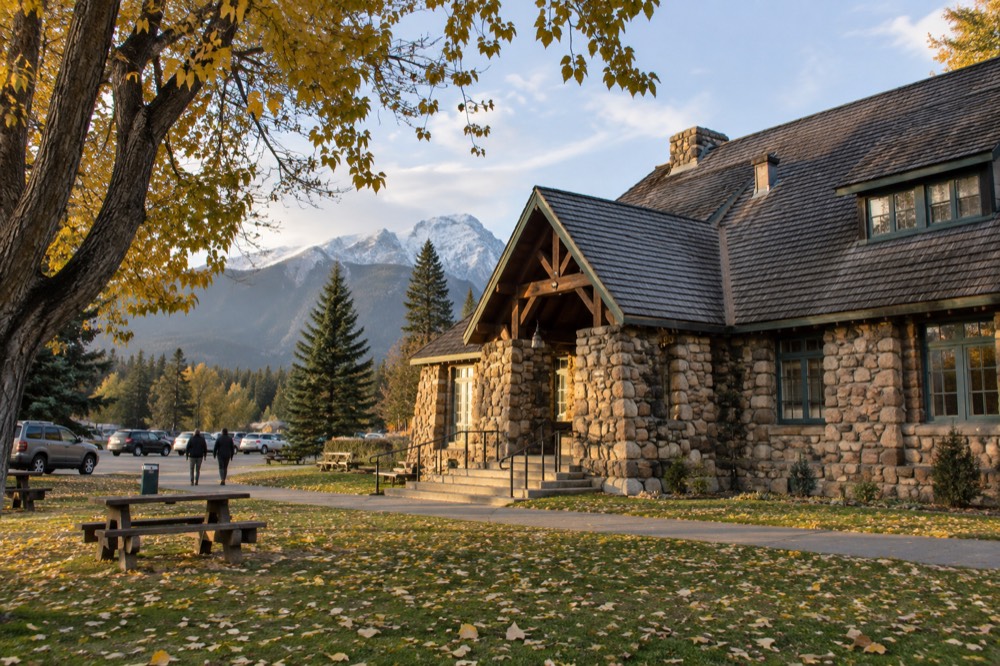
The Jasper Information Centre at 500 Connaught Drive deserves its own sentence rather than a passing clause. It is a National Historic Site in its own right, built in 1913 and described as one of the finest examples of the rustic design tradition in Canada's national parks. It is open 9 am to 7 pm from 14 May to 30 September 2026, and 9 am to 5 pm from 1 October 2026 to 31 March 2027. Walking in is free with your park presence, the building alone is worth ten minutes, and the staff inside are the best free resource in town for same-day trail conditions.
If what you actually want is a guide's knowledge rather than a free price tag, the paid side starts cheap. The interpretive nature walk product in the roster, a three-hour guided walk from $63.38, is the closest paid equivalent of the city walk a visitor might have been looking for, and it is the one to compare against doing the trail alone.
How Do You Watch Wildlife For Free Without Breaking The Rules?
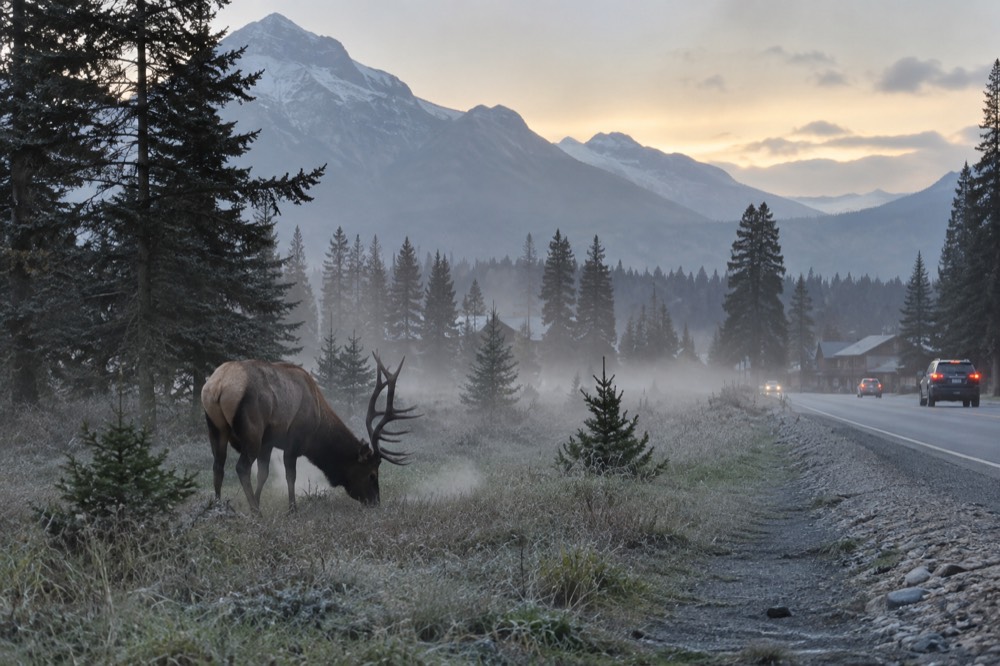
Wildlife watching from the road is free and rule-bound. Stay 30 m, three bus lengths, from elk, deer and moose, and 100 m, ten bus lengths, from bears and other carnivores. Roadside wildlife viewing is a designated restricted activity in Jasper all year: stay in your vehicle, use hazard lights, pull over only where it is safe, never stop in a driving lane, and move on if a jam forms. No tour required, and no sighting is ever guaranteed.
The free version of wildlife watching is driving the Maligne Valley or the Icefields Parkway at dawn or dusk with those rules in mind, and it works because the animals live here rather than being managed for viewing. Parks Canada's own species list for the park includes elk, deer, moose, caribou, bighorn sheep, mountain goats, bears, coyotes, wolves, beavers, pine martens, lynx, porcupines, cougars, snowshoe hares and wolverines. Bighorn sheep, mountain goats, coyotes and deer are named as commonly sighted along the Icefields Parkway in winter. Moose and Harlequin Ducks live in the open lodgepole pine and spruce forest at the north end of Maligne Lake.
The rules have teeth, and they protect both the animals and your wallet. It is an offence to entice, pet, harass or feed wild animals in the park, and pursuing animals with cameras counts as harassment. Drones are prohibited, with a fine of up to $25,000 CAD. On the trails, Parks Canada's guidance is to travel in groups, make noise, remove headphones, back away and return the way you came if you meet wildlife, and to carry bear spray and know how to use it. Report aggressive encounters to Parks Canada Dispatch on 780-852-6155. The full wildlife safety guidance is on Parks Canada's wildlife safety page.
A sighting is never a promise, from a tour operator or from this page. What a paid wildlife tour sells is not the animals, which are free, but the hours of driving, the guide who knows which valley is holding elk this week, and the vehicle. If you have your own car and patience, the free version is genuinely competitive. The site's guide to the best place to see wildlife in Jasper maps the where in detail.
What Does The Second Largest Dark Sky Preserve Cost To Look At?
Nothing. The night sky over Jasper is the single biggest free thing in the park. The Royal Astronomical Society of Canada designated Jasper National Park a Dark-Sky Preserve on 26 March 2011, and at over 11,000 square kilometres it is the second largest dark-sky preserve in the world. Looking up costs exactly zero, and the park's own seasonal notes tell you when the sky is at its best.
The seasonal calendar is the part most visitors never get told. The dense centre of the Milky Way arches overhead from July through September. The Perseids meteor shower peaks in mid-August. Andromeda rises in the east by September and is highest around midnight in October. Orion's belt climbs the eastern sky from November through February, the season of the Geminids. The Lyrids typically fall between 16 and 25 April. In other words, there is no bad season for the Jasper sky, only different shows, and the best free seats are any open day-use area after dark, Pyramid Beach and the lakes closest to town among them.
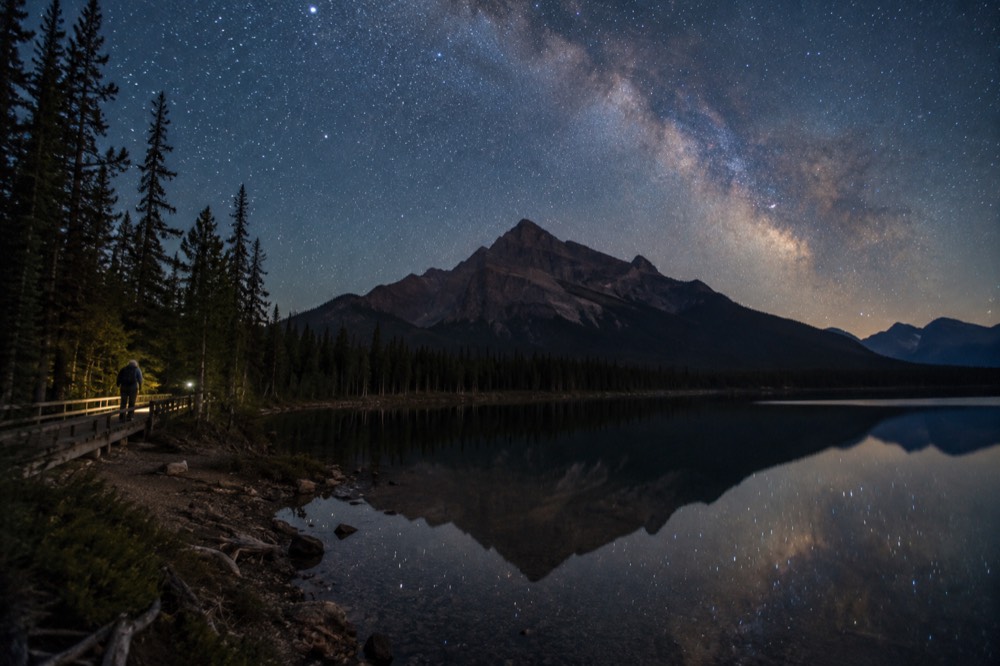
Tourism Jasper runs the Jasper Dark-Sky Festival every October, and the park celebrates Dark-Sky Month in October alongside it. The festival has ticketed events, but the phenomenon it celebrates does not, and a clear October night anywhere in the park delivers the headline experience without a wristband. Drive out of the townsite's glow, turn the car off, and give your eyes twenty minutes.
The paid edge of the sky is small and specific: the planetarium and telescope products in town, and the SkyTram's stargazing evenings, which put you at altitude with darker horizons. Neither is necessary. The free list already includes the second largest dark-sky preserve on Earth, which is a sentence worth reading twice.
| Season | Free night-sky highlight |
|---|---|
| April | Lyrids meteor shower, typically 16 to 25 April |
| July to September | Dense centre of the Milky Way arching overhead |
| Mid-August | Perseids meteor shower at its peak |
| September to October | Andromeda rising, highest around midnight in October |
| November to February | Orion's belt climbing the eastern sky, Geminids season |
| Every October | Dark-Sky Month and the Jasper Dark-Sky Festival |
Where Does Free Run Out And Paying Start To Make Sense?
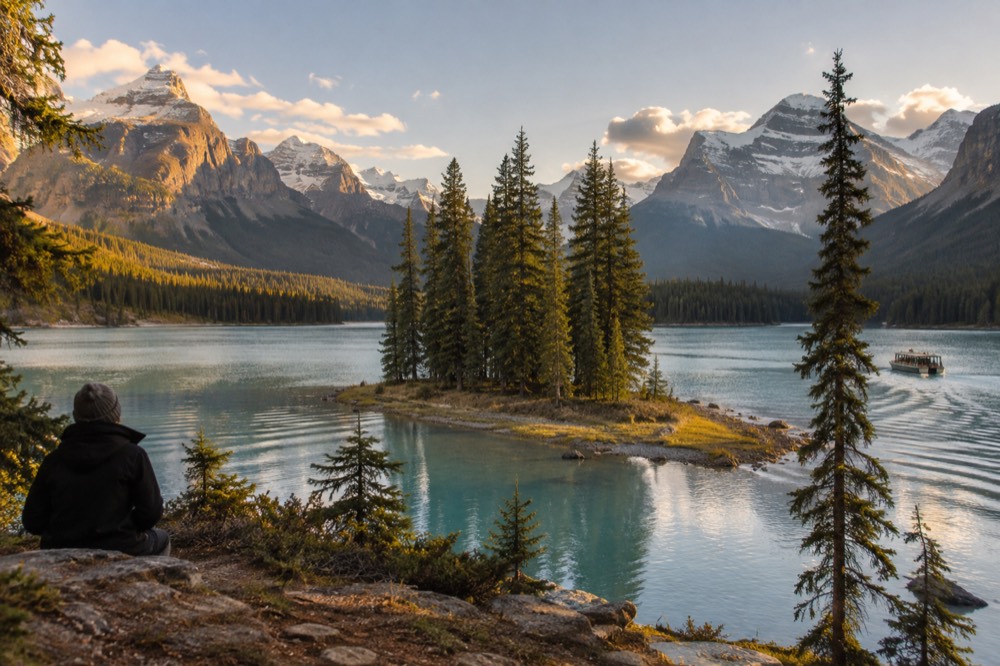
Free runs out at three hard walls. Spirit Island is 14 kilometres up Maligne Lake with no road or trail access, and Parks Canada states that tour boats or private non-motorized craft are the only means of reaching it. The Athabasca Glacier surface cannot be walked on without a guided trip. And a visitor without a car cannot reach the parkway stops at all. Those gaps are real, and the paid tours here exist to fill exactly them.
Take them in order, because each one has a different shape. Spirit Island, the postcard view that Maligne Lake is famous for, is simply not a free destination. There is no trail, no road, no viewpoint on shore. The 90-minute lake cruise from $87.45, running 27 May to 11 October in 2026, weather dependent, is the standard way in, and the longer valley tours bundle the cruise with the wildlife drive. If the island is the reason you came, the cruise is not an optional upgrade, it is the only door.
The glacier is the second wall, and it deserves precision. You can see the Athabasca Glacier for free from the Toe of the Glacier trail, and you should, because Parks Canada calls it Canada's most accessible glacier and the view costs nothing. What you cannot do is step onto it. The glacier is dangerous: Parks Canada's own words are that people have been killed falling into deep, hidden cracks called crevasses, and the barriers exist for that reason. Walking on the ice requires a guided product, whether that is the Ice Explorer vehicle experience from $95.17, or the guided glacier hike from $101.57, a three-hour trip on foot with crampons and a guide. The free trail and the paid ice are two different experiences of the same glacier, and both are legitimate.
The third wall is transport, and it is the one people forget until they are standing at the bus stop. Jasper's free list is a driving list. Athabasca Falls is 30 km away, Sunwapta Falls 54 km, the Icefield Centre 103 km, and there is no free shuttle connecting any of them. A visitor without a car has essentially the townsite, the lakes near town, and whatever paid transport they book. That is the honest boundary of this page, and it is why the paid roster on this site is not a contradiction of the free list but its continuation: the tours are how the carless, the time-poor and the ice-bound reach the parts of Jasper the pass alone cannot get them to.
| Free experience | Where free stops | What fills the gap |
|---|---|---|
| Toe of the Glacier trail | At the barrier: no walking on ice | Guided glacier hikes, Ice Explorer |
| Maligne Lake shoreline | No road or trail to Spirit Island | The 90-minute cruise |
| Icefields Parkway viewpoints | No transport without a vehicle | Guided parkway day tours |
| Night sky from any open area | No equipment or altitude | Planetarium and telescope combo |
| Wildlife from the roadside | No guide, no guarantee | Guided wildlife tours with pickup |
None of this makes the park pass a rip-off, and this page will not frame it that way. Twelve dollars and a quarter, Canadian, for a day among the falls, the lakes, the trails and the second largest dark-sky preserve on the planet is one of the better deals in North American travel, and the family cap means most cars pay no more than $24.50. The honest summary of Jasper National Park Tours as a destination is that the free list is long, the paid list is short, and the paid list exists only where geography insists on it.
Common questions about free things to do in Jasper National Park
Is entry to Jasper National Park free?
No. A park pass is legally required, and the Canada Strong Pass free-admission period ended on 7 September 2026. Adult daily admission is $12.25 CAD, senior $10.75 CAD, youth 17 and under free, and a Family/Group daily rate of $24.50 CAD covers up to seven people in one vehicle.
What can you do in Jasper for free?
Athabasca Falls, Sunwapta Falls, Medicine Lake, the Valley of the Five Lakes trail, Old Fort Point, Pyramid Beach and Pyramid Island, Patricia, Annette and Edith lakes, the Jasper Information Centre, and the night sky over the dark-sky preserve are all free beyond the park pass.
Is the Valley of the Five Lakes trail open?
Yes. It reopened in summer 2026 after realignment, resurfacing, new signage and new rest areas, and more than 800 visitors walked it on opening day.
Can you see Spirit Island for free?
No. Spirit Island is 14 kilometres up Maligne Lake with no road or trail access, and Parks Canada states that tour boats or private non-motorized craft are the only means of reaching it.
Is Maligne Canyon free to visit?
Maligne Canyon is closed for the 2026 season, from the First Bridge parking lot to the Fifth Bridge junction, including winter access. Entering a closed area carries a maximum penalty of $25,000 CAD.
Is there a free guided walking tour in Jasper?
No. No free or pay-what-you-want guided walking tour is listed for Jasper by any operator, and the free-tour platforms covering Canada have no Jasper listing at all. Every guided walk in Jasper is a paid, booked product.