Are The Columbia Icefield And Athabasca Glacier The Same Thing?
No, they are not the same thing: the Columbia Icefield is a 300-plus square kilometre mass of ice and the Athabasca Glacier is one tongue of it that you can actually walk on. Here is how to tell them apart before you book.
Are The Columbia Icefield And Athabasca Glacier The Same Thing?
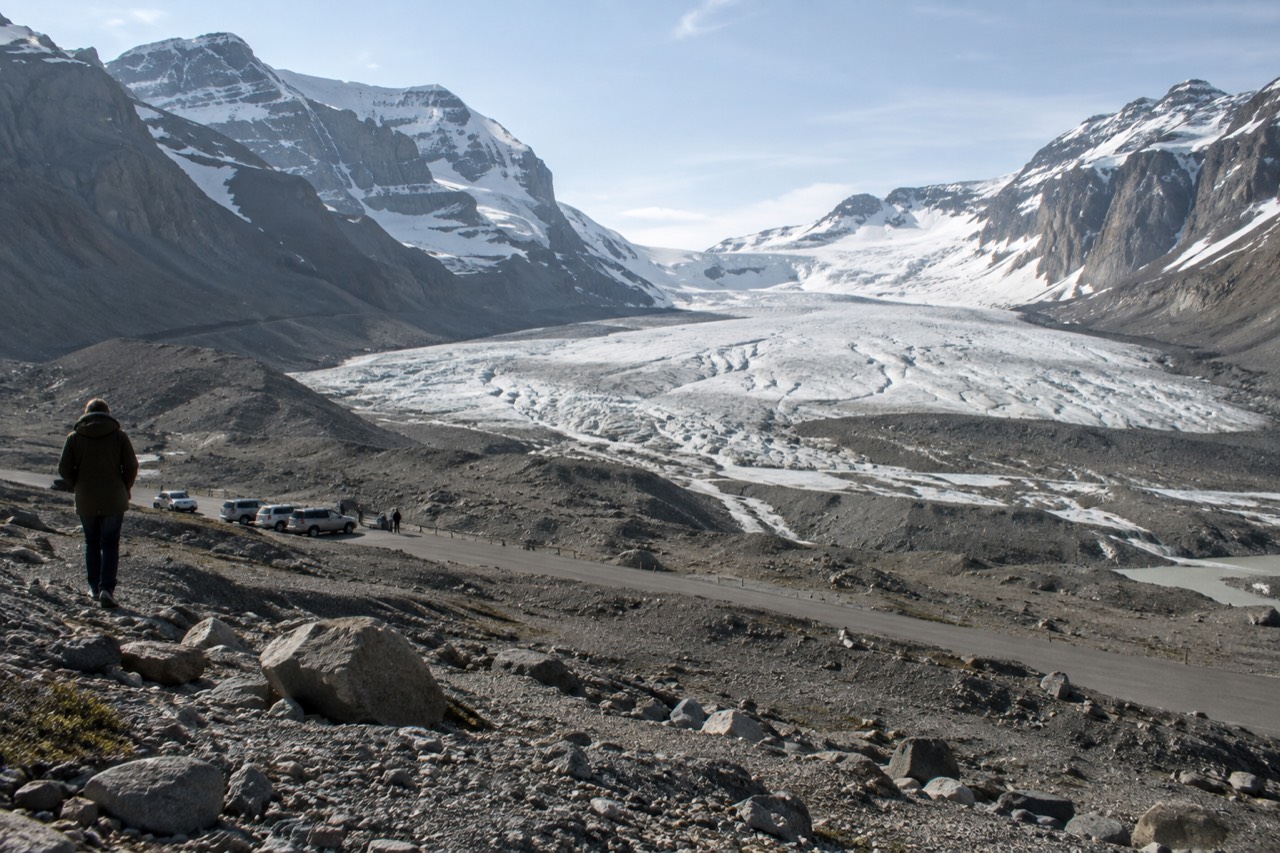
No, they are two different things at different scales, and the distinction matters. The Columbia Icefield is the parent body: a mass of ice covering more than 300 square kilometres, the largest icefield in the Canadian Rockies. The Athabasca Glacier is one tongue of ice that spills out of that icefield and down toward the road. Every glacier tour you can book in the area touches the Athabasca Glacier, not the icefield as a whole.
The confusion is understandable because the naming on tours is genuinely messy. One product is called the Columbia Icefield Adventure, another is the Columbia Icefield Skywalk, a third is a guided hike on the Athabasca Glacier, and several use both words in the same title. A traveller scanning listings at speed could easily conclude that icefield and glacier are interchangeable labels for the same attraction. They are not, and the difference decides whether you end up standing on ice or looking at ice from a glass walkway.
Think of it as a lake and a river. The icefield is the reservoir, sitting high on the continental divide, accumulating snow that compresses into ice over decades. The glacier is the outflow: ice thick enough to flow, squeezed through a low point in the bedrock and creeping downhill a few tens of centimetres a day. The Athabasca Glacier is the most famous of the icefield's outflows because it is the one that reaches within walking distance of a highway, which is exactly why Jasper National Park Tours and every other tour operator in the region can sell access to it.
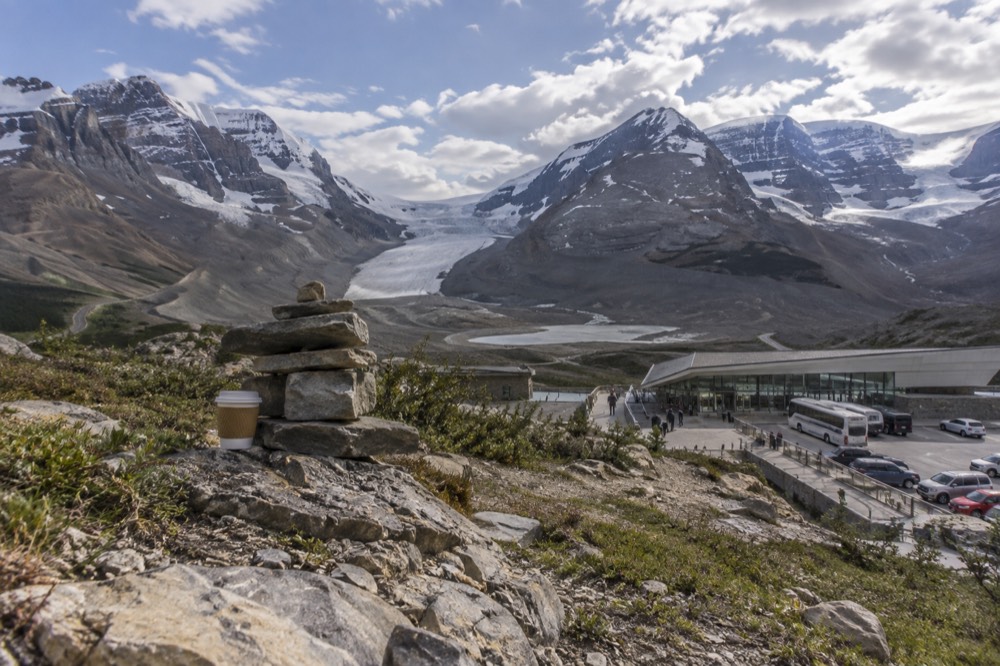
Parks Canada describes the relationship plainly: the Athabasca Glacier spills from the Columbia Icefield over three giant bedrock steps and sits across the road from the Icefield Centre, 103 km south of Jasper on Highway 93. The agency calls it Canada's most accessible glacier. The icefield itself, by contrast, is a backcountry expanse that no road and no tour reaches; you see it from the toe of the glacier, from the Skywalk, and from viewpoints along the Icefields Parkway. For the full picture of what operators run out there, our guide to Columbia Icefield tours from Jasper breaks down every product by what you actually stand on.
If you already know you want the guided day trip that strings the glacier, the Skywalk and Athabasca Falls together, these three are the ones travellers compare first:
The seven-hour guided option in that set is the one that answers this article's question most directly, because its itinerary names both features in sequence: you ride an Ice Explorer onto the Athabasca Glacier, then walk the Columbia Icefield Skywalk above the Sunwapta Valley. Booking it makes the icefield-versus-glacier distinction physical rather than theoretical.
What exactly is the Columbia Icefield?
The Columbia Icefield is the largest icefield in the Canadian Rockies, a surviving remnant of the ice mass that once mantled most of Western Canada's mountains, covering more than 300 square kilometres of ice. It sits high on the continental divide, feeding meltwater toward three oceans, and no road or trail takes you onto it. Tours that use its name take you to its edges, not onto the icefield itself.
An icefield is a different landform from a glacier, and the difference is worth thirty seconds of thought. An icefield is a broad, continuous sheet of ice that fills a mountain basin, thick enough in places to bury the peaks except for the highest summits, which poke through as nunataks. A glacier is what happens when ice from that sheet finds an exit and begins to flow under its own weight, carving a valley as it goes. The Columbia Icefield is the basin; the Athabasca, the Saskatchewan, the Dome and the Castleguard are among the exits.
The scale is the part that surprises people. More than 300 square kilometres of ice sits up there, and it is not a flat, featureless cap: it is divided by flow-shed divides into around 25 distinct glaciers for monitoring purposes, each with its own accumulation zone and its own melt rate. Parks Canada's glacier programme tracks the whole icefield with satellite imagery and airborne LiDAR, which is where the retreat figures come from: over the 1985 to 2024 period the Columbia Icefield lost nearly 13.3 percent of its ice, and between 2017 and 2024 alone it lost about 1.5 cubic kilometres. Those numbers are measured, not modelled.
One geographical detail makes the icefield genuinely rare rather than just big. Mount Snowdome, on the icefield, is one of only two hydrological apexes in North America: a triple continental divide where meltwater flows toward the Pacific, the Arctic and the Atlantic from one mountain of ice. Very few places on the continent can make that claim, and it is one reason this stretch of the Rockies was inscribed with UNESCO in 1990 as part of the Canadian Rocky Mountain Parks World Heritage Site.
You do not visit the icefield, though. You visit its edges, and the main edge is the Athabasca Glacier. The practical question for a traveller is which products put you where, and the honest answer is that everything bookable from Jasper lands on or beside the Athabasca Glacier. If you are weighing whether the full day trip earns its price, our write-up asking is the Columbia Icefield tour worth it goes through the trade-offs.
What exactly is the Athabasca Glacier?
The Athabasca Glacier is one tongue of ice flowing out of the Columbia Icefield, spilling over three giant bedrock steps toward the Icefields Parkway. It is Canada's most accessible glacier, which is why every glacier walk, Ice Explorer ride and viewpoint tour in the area happens on it rather than on the icefield. It has been receding for the last 125 years, and Parks Canada warns visitors never to cross the barriers onto the ice alone.
This is the glacier you have seen in photographs whether or not you knew its name: a broad white-and-blue tongue flanked by dark lateral moraines, with the Icefield Centre and its parking lots directly across the highway. Access is the whole story. The Columbia Icefield is remote and roadless; the Athabasca Glacier is close enough to a major highway that a tour bus can deliver you to its toe in a morning, and operators run guided walks straight onto the ice with crampons and a certified guide.
The glacier is also the part of the system that is visibly changing. It has been receding for 125 years, and Parks Canada states that 2023 saw more glacier ice melt than in any of the previous 10 years. Across the park as a whole, Jasper lost 21.8 percent of its total glacier mass between 1985 and 2024, and the agency says that if current trends continue the park's glaciers will disappear within the next century. The marker signs near the parking area showing the glacier's former extent make the retreat concrete in a way few statistics do.
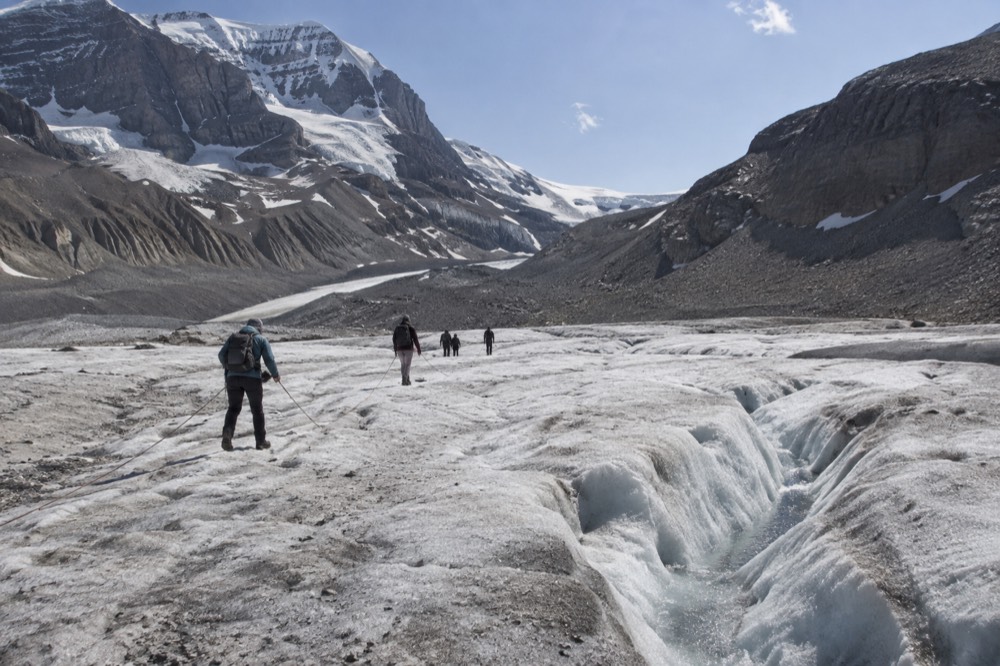
Safety is the other reason the glacier and the icefield get conflated in listings. Parks Canada's own wording is blunt: the glacier is dangerous, people have been killed falling into deep, hidden crevasses, and visitors should not cross the barriers. The meltwater ice caves that form in summer are dangerous and should not be entered. Everything safe on the ice happens with a guide or inside an Ice Explorer vehicle, and the free, self-guided option is limited to the toe-of-the-glacier viewpoint trail, which stays off the ice entirely.
That is the practical case for the guided day tour: it handles the glacier access, the timing and the driving on one of the park's most demanding roads, all in a single booking. If you would rather walk on the ice with a small group and a guide instead of riding onto it, our guide to Athabasca Glacier tours and ice walks compares the guided hike options against the vehicle-based ones.
Which tours put you on the glacier, and which only show you the icefield?
Tours divide cleanly into three types: glacier-access products that put you on the Athabasca Glacier's ice, viewpoint products such as the Skywalk that show you the glacier and the icefield from beside and above it, and full-day tours that combine both. Nothing bookable from Jasper puts you onto the Columbia Icefield itself. Reading a listing's confirmed stops before booking is how you tell which type you are buying.
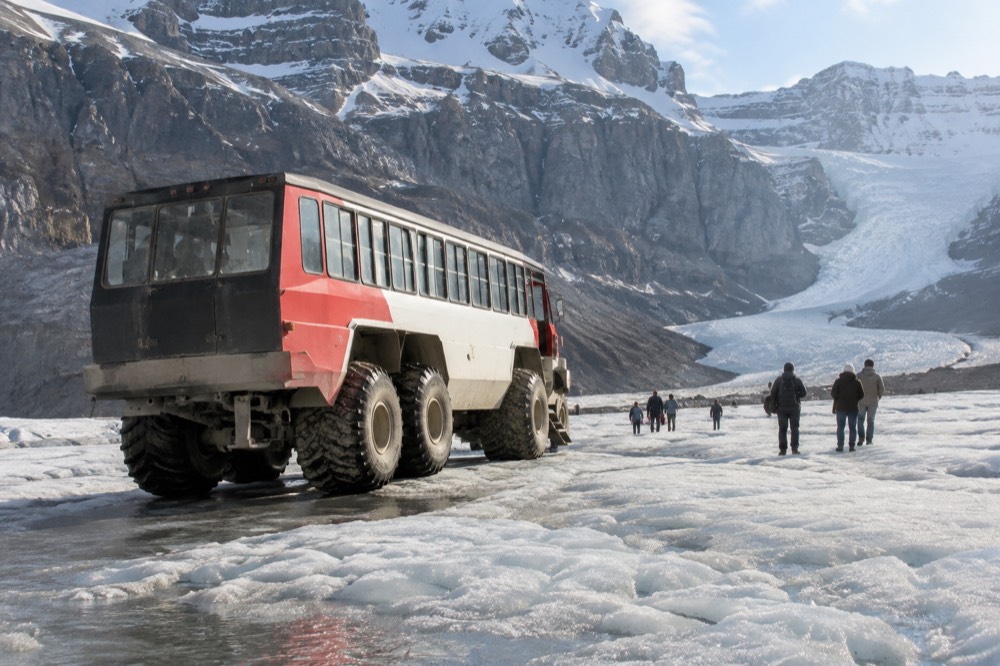
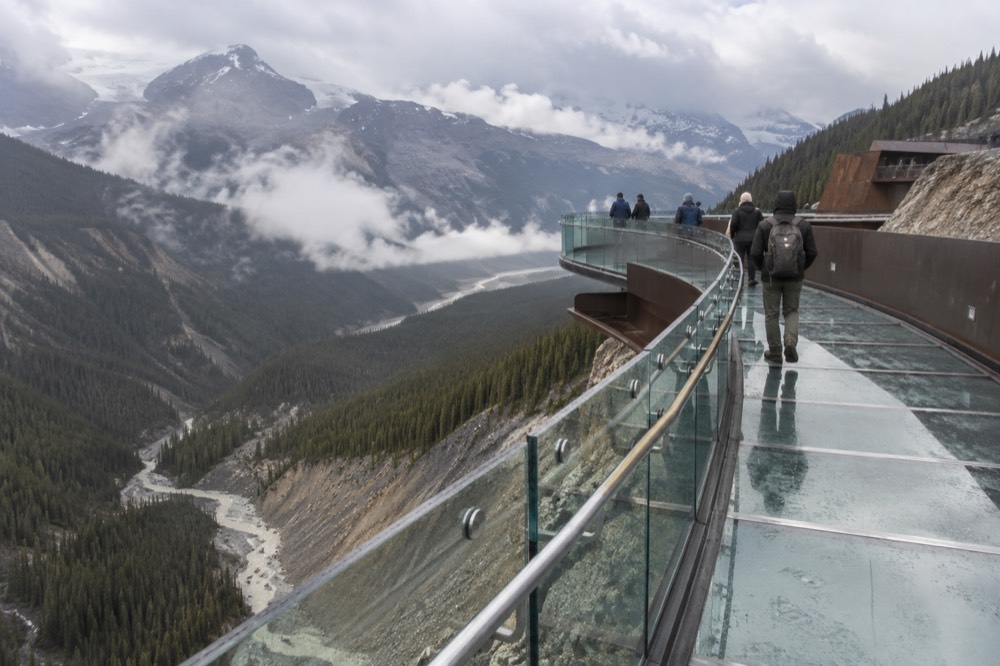
The distinction sounds obvious, but listings blur it. A product named for the Columbia Icefield may include no time on ice at all. The Skywalk, for instance, is a glass-floored walkway fixed to the cliff above the Sunwapta Valley: it looks across at the glacier and out toward the icefield, and it is a superb viewpoint, but nobody sets foot on ice there. The Ice Explorer, by contrast, is a purpose-built all-terrain vehicle that drives down onto the Athabasca Glacier and lets passengers stand on it. Same attraction area, opposite experiences.
The combo ticket above is the clearest example of how the two names map onto two different activities: the Ice Explorer portion is the glacier, the Skywalk portion is the viewpoint over the valley the glacier feeds. If a listing you are considering does not name the Ice Explorer or a guided glacier walk, assume it is a viewpoint product and plan accordingly.
Guided walks are the third type, and they are the most direct answer to the question this article asks. The IceWalks guided glacier hike runs three hours on the Athabasca Glacier with a guide, rated 4.9 across 422 reviews, and the Tread Lightly hikes run a four-hour version. Both list the Athabasca Glacier as their confirmed stop, not the icefield, because the icefield is not where a walking tour can operate. The small-group Ice Odyssey experience lists the glacier and the Discovery Centre and runs about two hours.
Here is the full spread in one table, using each product's confirmed stops and listed figures:
| Product | What you actually touch | Confirmed stops | Rating | From (per person) |
|---|---|---|---|---|
| Ice Explorer and Skywalk combo | Stand on the glacier, then the Skywalk | Athabasca Glacier, Skywalk, Discovery Centre | 4.5 across 3187 reviews | $95.17 |
| Skywalk admission only | Viewpoint only, no ice | Skywalk, Sunwapta River, Discovery Centre | 4.4 across 1050 reviews | $37.01 |
| 7-hour guided icefield tour | Glacier via Ice Explorer, plus Skywalk and Athabasca Falls | Athabasca Glacier, Skywalk, Athabasca Falls, Discovery Centre | 4.6 across 213 reviews | $248.08 |
| IceWalks guided glacier hike | Walk on the glacier ice with a guide | Athabasca Glacier, Discovery Centre | 4.9 across 422 reviews | $101.57 |
| Tread Lightly glacier hike | Walk on the glacier ice, four hours | Athabasca Glacier | 4.8 across 198 reviews | $135.25 |
| Ice Odyssey small group | Small-group glacier experience | Athabasca Glacier, Discovery Centre | 4.9 across 36 reviews | $201.66 |
One more thing worth knowing before you book: the glacier season is finite. The Columbia Icefield Adventure, which includes the Ice Explorer, runs 1 May to 12 October in 2026, weather dependent. The guided hikes run inside a similar window, because the ice surface and the access road to the toe both depend on conditions. Operators publish seasons as weather dependent, so treat the months as the pattern and confirm the date on the operator's live listing when you book.
Does the difference change what you should book?
Yes, materially. If you want to say you stood on a glacier, you need an Ice Explorer or guided-walk product, and the icefield's name in a title tells you nothing about that. If you mainly want the view, the Skywalk alone costs a fraction of the glacier-access products. If you want the whole picture, glacier plus viewpoint plus the drive down the Icefields Parkway, the full-day guided tour is the product built for it.
Start with what you want to feel, not with the names. Standing on the Athabasca Glacier's ice, crampons crunching, with the crevasses and meltwater streams around you, is a different day from standing on a glass platform looking at the valley below. Travellers who book the Skywalk expecting glacier access, or who book a glacier walk expecting a relaxed viewpoint stop, are the ones who leave disappointed, and the reviews that mention that disappointment almost always trace back to the naming confusion this article exists to clear up.
Budget follows the same logic. Skywalk-only admission starts at $37.01, the Ice Explorer and Skywalk combo starts at $95.17, guided glacier hikes start around $101.57, and the full seven-hour day from Jasper starts at $248.08. That is a spread of nearly seven times from the cheapest to the priciest, for experiences that all sit within a few hundred metres of each other. Knowing which experience you are buying is worth more than any other piece of planning at this attraction.
The full-day tour deserves a specific word because it is the one that resolves the question by geography. It drives the Icefields Parkway from Jasper, stops at Athabasca Falls, reaches the glacier and the Skywalk, and returns, all in 7 hours 15 minutes with a guide narrating the landscape. You get the icefield as scenery, the glacier underfoot, and the valley between, which is the complete answer to what these two things are and how they relate. It also lists free cancellation, which matters for a weather-dependent product.
A few planning points that apply whichever product you choose. A park pass is legally required to be in Jasper National Park and to drive the Icefields Parkway, and the daily fee is charged per person in Canadian dollars, with a Family/Group rate of $24.50 CAD covering up to seven people arriving in one vehicle; whether a tour absorbs that fee varies by operator, so check each listing's inclusions rather than assuming. There is no cell coverage along the parkway and no winter services, so travel with what you need. And the Columbia Icefield area sits at elevation: even in July, the daily maximum at the Jasper station averages 23.4 °C while the glacier toe stays cold and windy, so layers are not optional. Our piece on what to wear to the Columbia Icefield covers the packing side in detail.
If you are comparing the two flagship experiences rather than deciding between glacier and viewpoint, the question usually comes down to the guided walk versus the vehicle ride, and the honest summary is this: the walk is slower, smaller and more physical, the ride is faster, bigger and accessible to nearly everyone. Both are on the same glacier. Neither is on the icefield. Book the one whose description names what you actually want to do, and the naming confusion stops costing you anything.
Common questions about the Columbia Icefield and the Athabasca Glacier
Are The Columbia Icefield And Athabasca Glacier The Same Thing?
No. The Columbia Icefield is a mass of ice covering more than 300 square kilometres, the largest in the Canadian Rockies. The Athabasca Glacier is one tongue of ice that flows out of that icefield toward the Icefields Parkway. Tours named for the icefield take you to the glacier's edge, not onto the icefield itself.
Can you walk on the Columbia Icefield?
No bookable tour puts you on the icefield itself. The ice you can walk on is the Athabasca Glacier, either on a guided hike with a certified guide or as a passenger on an Ice Explorer vehicle. The icefield is a roadless backcountry expanse that you view from the glacier's toe, the Skywalk and the parkway.
Is the Athabasca Glacier part of the Columbia Icefield?
Yes. The glacier spills from the icefield over three giant bedrock steps, and the ice it carries today accumulated as snow high on the icefield years before reaching the valley. The icefield feeds several glaciers; the Athabasca is simply the most accessible one.
Why do tour names use both words if they are different things?
Because the tours visit the area where the two meet. A product named for the Columbia Icefield typically includes the Athabasca Glacier, the Skywalk and the Discovery Centre, all of which sit at the boundary between the two. Reading the confirmed stops on a listing is the reliable way to see which features a tour actually includes.
Which one should I book if I only have time for one?
Decide whether you want to stand on the ice or look at it. Glacier access means the Ice Explorer combo from $95.17 or a guided hike from around $101.57. A viewpoint day means Skywalk admission from $37.01. If you want both plus the drive and Athabasca Falls, the seven-hour guided tour from Jasper covers everything in one booking.
Is the Athabasca Glacier melting?
Yes, and measurably. It has been receding for the last 125 years, and Parks Canada states that 2023 saw more glacier ice melt than in any of the previous 10 years. Between 1985 and 2024 the Columbia Icefield lost nearly 13.3 percent of its ice, and the agency says the park's glaciers could disappear within the next century if current trends continue.
If you are still weighing the options, these three cover the range: the full-day guided tour, the glacier-plus-Skywalk combo, and a gentler small-group day on the water for contrast.